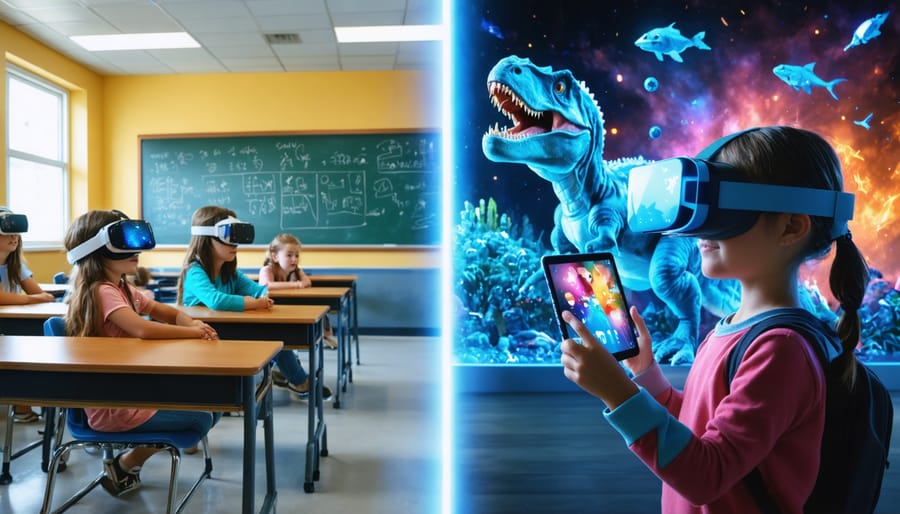
In 2026, the traditional “factory model” of education has been replaced by what is now known as Cognitive Education. This new approach emphasizes continuous learning through the integration of Artificial Intelligence (AI) tutors and Virtual Reality (VR)$365 billion, reflecting a global trend towards more personalized and immersive learning environments.
The rise of VR technology has led to an expected market value of $8.11 billion this year for educational applications. Students are no longer passive observers; they actively engage in subjects such as history through photorealistic simulations. For instance, instead of reading about the Roman Senate, students can participate in debates with AI-driven historical figures, transforming their educational experience into one of experiential learning.
Personalized Learning and Skills Verification
Modern education no longer revolves around traditional degrees but functions more like a subscription service for skills. The focus has shifted from merely “selling courses” to “verifying competence,” where students seek proof of their skills over simple certificates. Platforms like Buddy and Kyron Learning exemplify this trend by providing 24/7 personalized instruction. These AI tutors analyze students’ emotional states through voice recognition and facial analysis, allowing them to adjust lesson difficulty in real-time based on whether a student appears bored or frustrated.
Additionally, the emergence of Blockchain Micro-Credentials has made it possible to record every mastered module—from “Prompt Engineering” to “Quantum-Safe Ethics”—as verifiable badges. This innovation offers a secure way for employers to audit skills, as traditional degrees lose their dominance in the job market.
AI’s role in education extends beyond grading; it designs personalized learning paths tailored to individual student needs. Adaptive Learning Ecosystems replace standardized curricula, with AI analyzing a student’s prior knowledge and learning pace. Research indicates that this tailored approach can increase test scores by up to 62% by identifying and addressing knowledge gaps before they lead to poor performance.
Impact on Educators and Corporate Training
The integration of AI tools in education has freed teachers from administrative burdens, with 69% of educators reporting improved teaching effectiveness. This shift allows teachers to concentrate on mentoring, emotional intelligence, and critical thinking—skills that machines cannot replicate. The role of educators has transformed into that of high-impact mentors who guide students through a constantly evolving landscape.
The boundaries between education and the workplace are increasingly blurred. 75% of Fortune 500 companies now employ VR and AI for internal training, effectively turning many organizations into educational institutions. This trend emphasizes the importance of “Agency” in hiring practices, as companies seek employees who possess both technical skills and the ability to adapt.
Global collaboration has also been enhanced through real-time AI translation, enabling students from different continents to engage in projects. For example, a student in Lahore can participate in a VR workshop at MIT, collaborating with peers from around the world.
Despite these advancements, the education sector faces challenges. Concerns about the potential loss of independent thought arise as AI takes over analytical tasks. Educators must ensure that students learn to use AI as a tool, not a crutch. Furthermore, there have been instances of algorithmic bias where automated assessments have disproportionately affected students from low-income communities. The industry is under pressure to develop ethical AI governance that guarantees equity and transparency in grading processes.
Looking ahead to 2030, the aim is to ensure that “No Learner is Left Behind.” With affordable AI tutors and satellite internet, the vision is to provide quality education to every child globally, irrespective of their geographical or socio-economic background. As technology, business, digital marketing, and artificial intelligence converge, education is becoming a lifelong journey. The key to success in this new paradigm is the understanding that “Information” is no longer the primary differentiator; instead, the ability to learn and adapt will define the future of education.