A South Korean mathematician has resolved one of geometry’s most perplexing challenges, known as the “moving sofa problem,” which has stumped researchers for nearly six decades. Dr Baek Jin Eon, a 31-year-old research fellow at the Korea Institute for Advanced Study, proved that no shape larger than the one proposed by Joseph Gerver can navigate through a right-angled corridor of fixed width.
The moving sofa problem, first posed in 1966, poses a seemingly straightforward question: what is the two-dimensional shape with the largest possible area that can be transported through an L-shaped corridor measuring just one unit in width? Despite its simple premise, the problem has resisted a definitive proof for decades. In 1992, mathematician Joseph Gerver suggested a complex curved shape, known as Gerver’s sofa, as a potential solution. Yet, no one had been able to demonstrate that a larger shape could not exist until now.
After seven years of diligent research, Dr Baek published his comprehensive proof spanning 119 pages on the preprint server arXiv in late 2024. He concluded that “no sofa wider than Gerver’s sofa can exist,” marking a significant milestone in mathematical research. Notably, Dr Baek’s proof is distinguished by its reliance solely on logical reasoning, diverging from many previous attempts that depended on large-scale computer simulations.
Reflecting on his extensive research journey, Dr Baek described the process as one of continuous rebuilding and re-evaluation. “You keep holding on to hope, then breaking it, and moving forward by picking up ideas from the ashes,” he explained in an interview. He characterized his approach to mathematics as akin to “a repetition of dreaming and waking up,” underscoring the persistence required to tackle such a challenging problem.
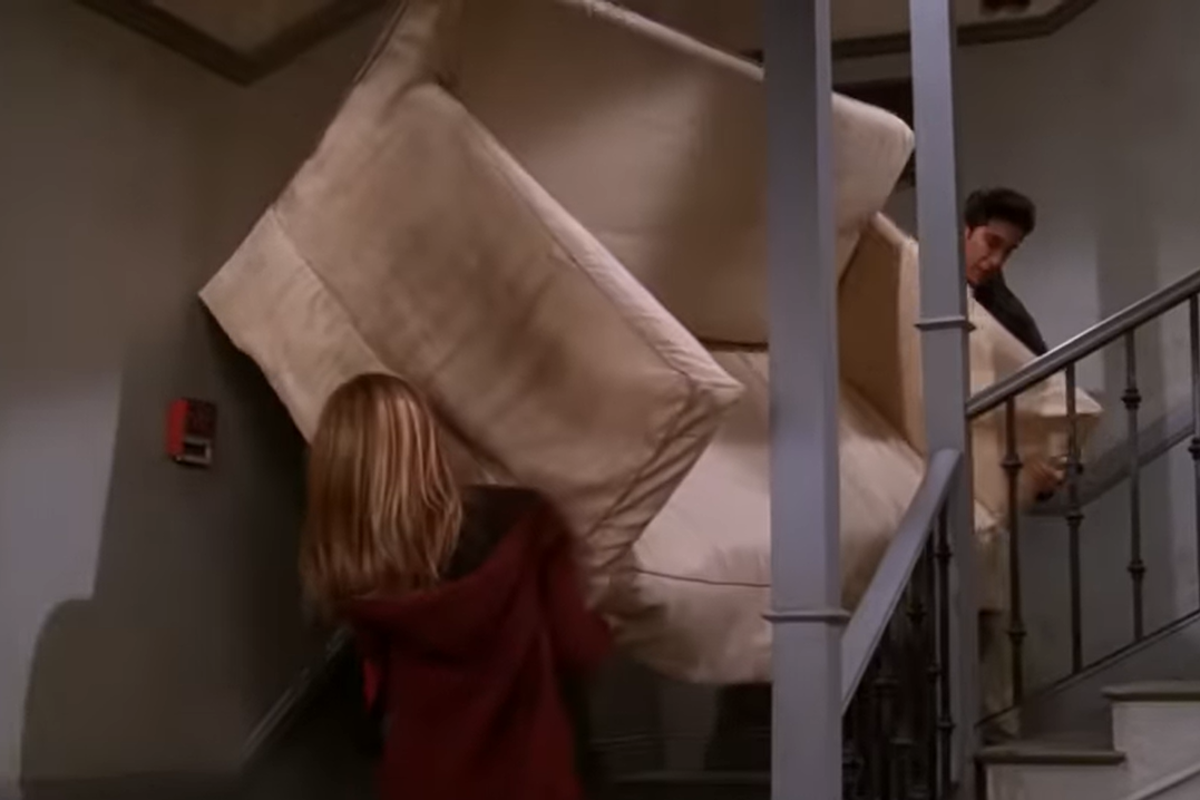
The significance of Dr Baek’s work has been recognised within the academic community. Scientific American named his achievement one of the “Top 10 Math Discoveries of 2025,” highlighting the unusual aspect of his solution being free from computational assistance. The magazine quipped that “explaining the ‘Pivot!’ shouted by Ross Geller required a 119-page paper,” referencing the cultural impact of the moving sofa problem, which was famously depicted in the US sitcom Friends.
Currently, Dr Baek’s proof is under peer review at the Annals of Mathematics, a prestigious journal in the field. Though the review process is ongoing, confidence in the validity of his findings is strong among mathematicians. Dr Baek began his exploration of this problem while serving as a research specialist during his mandatory military service. He continued through his doctoral studies in the United States and later as a postdoctoral researcher in South Korea.
In recognition of his potential, Dr Baek was selected last year for the June E Huh Fellow programme, which supports promising young mathematicians under 39 for up to ten years. He is now pursuing further work on optimization problems and challenges in combinatorial geometry, continuing to push the boundaries of mathematical research.
This breakthrough not only resolves a long-standing mathematical conundrum but also emphasizes the power of perseverance and innovative thinking in the field of mathematics.