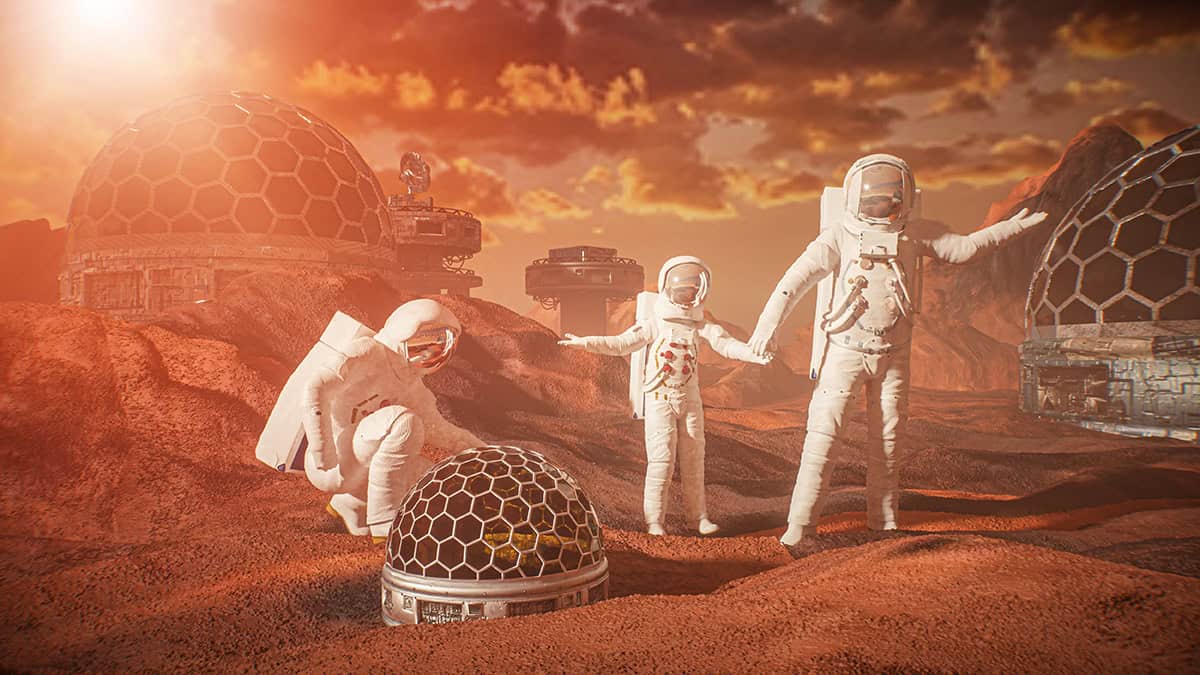
In his latest book, Becoming Martian: How Living in Space Will Change Our Bodies and Minds, author and research biologist Scott Solomon examines the profound effects that life on Mars would have on the human body and mind. With an increasing focus on space exploration, Solomon’s work highlights the unique biological challenges humanity faces as it contemplates sending people to the Red Planet.
Understanding the Challenges of Martian Life
Solomon reflects on the evolution of humanity’s ambition to reach Mars, noting that just a decade ago, returning to the Moon felt like a distant dream. Today, we find ourselves in a new era of space exploration, where the first individuals destined for Mars may already be born. While the technology for transporting humans to Mars and sustaining them is theoretically feasible, the book emphasizes that the biological and ethical barriers are significant.
The initial chapters provide a comprehensive overview of Mars, juxtaposing its mythology and culture with scientific exploration. Solomon underscores that Mars is fundamentally different from Earth, presenting unique challenges to human survival. He details known effects of space travel, such as anaemia, muscle atrophy, bone density loss, and heightened exposure to radiation, all of which significantly impact human health.
The Biological and Ethical Implications
One of the book’s most compelling aspects is Solomon’s focus on the evolutionary ramifications of Martian life. For instance, he points out that childbirth on Mars, where gravity is approximately one-third that of Earth, would be exceedingly perilous. The decrease in bone density could lead to an increase in pelvic fractures, and the reduced muscle strength might hinder the uterus’s ability to contract effectively. Consequently, Solomon predicts that all births on Mars would likely necessitate C-sections.
Solomon also examines how living in Mars’s environment would alter human microbiomes, potentially affecting immune systems to the extent that Earthlings could pose a health risk to Martians. He asserts, “More than any other factor, the risk of disease transmission may be the wedge that drives the separation between people on the two planets.” The implications of this separation extend to dietary choices, suggesting that Martians might adopt a vegan lifestyle and forgo pets, as many zoonotic diseases are transmitted through animals.
The book further explores the intersection of biological and psychological research with the technical aspects of a Mars mission. For example, Solomon recommends that the initial exploratory teams consist of odd numbers to facilitate decision-making and minimize divisions within the group. To ensure genetic diversity and mitigate risks of population crashes, he suggests that the first Martian colonies should comprise between 10,000 and 11,000 individuals.
Despite the gravity of the subject matter, Solomon’s writing is both engaging and accessible. He navigates complex topics, such as NASA’s historical health studies and genetic engineering, with clarity. His impartial presentation of conflicting ethical viewpoints allows readers to form their own opinions, making for a thought-provoking read.
In the concluding epilogue, Solomon reveals his own stance on the colonization of Mars, arguing that it may ultimately be our biology—not our technology—that constrains humanity’s expansion to the Red Planet. If we manage to overcome these biological limitations, either through genetic engineering or natural evolution, it raises the question of whether we would lose a part of what makes us human.
Becoming Martian stands out as a significant contribution to popular science literature, combining thorough research with a hopeful outlook. Whether one is contemplating a future on Mars or simply curious about the feasibility of human reproduction in space, this book is a valuable addition to any reading list.