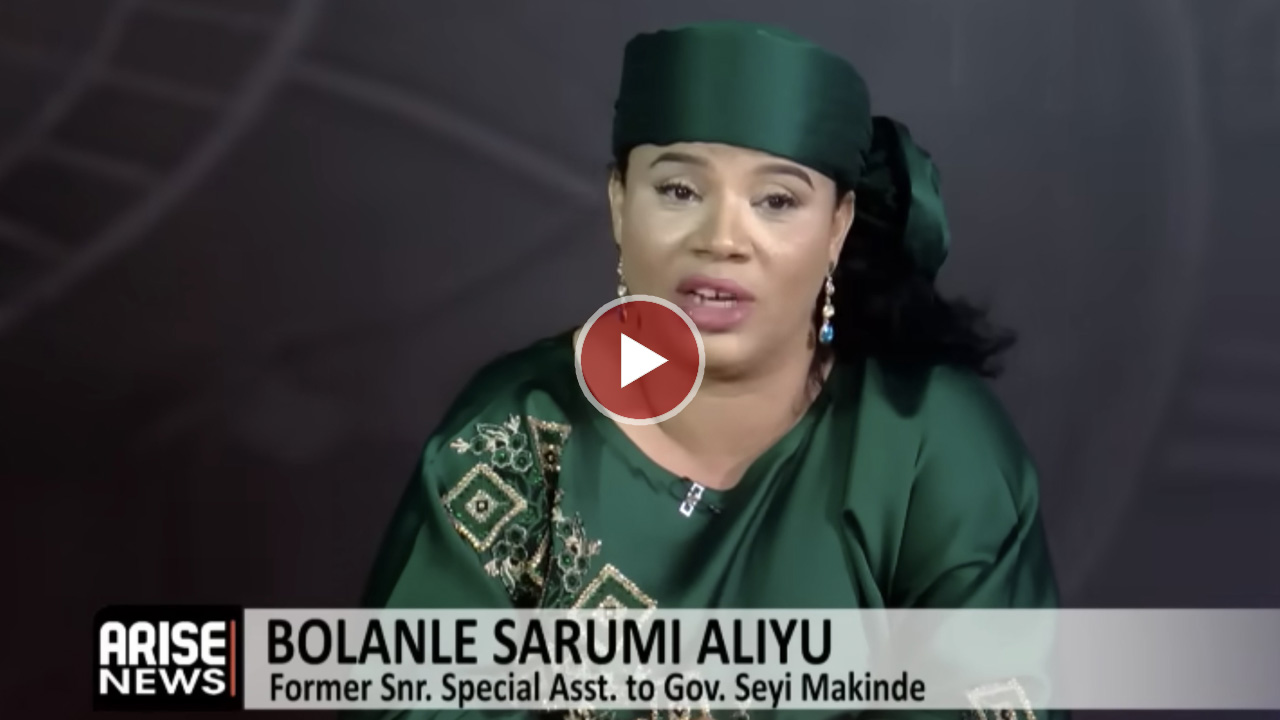
The ongoing impeachment crisis in Rivers State, Nigeria, has been described by former governorship candidate Bolanle Sarumi Aliyu as a direct result of the country’s pervasive money politics. Speaking on ARISE News on March 15, 2024, Sarumi Aliyu warned that without addressing the financial influences in governance, democracy in Nigeria may continue to suffer. The conflict between Governor Siminalayi Fubara and his former political ally, Minister of the Federal Capital Territory Nyesom Wike, reflects deeper issues of financial control rather than governance or ideology, according to her.
Sarumi Aliyu emphasized that the high cost of elections in Nigeria fosters a system of godfatherism, where those who contribute financially expect to exert control over elected officials. She stated, “In Nigeria, you need to spend billions and billions of naira to become a governor. So definitely there will be drama. One person makes you governor, and then that person wants to control you.” This financial strain leads to unspoken agreements that often unravel once power is secured, contributing to the political instability the state currently faces.
Drawing from her own experiences, Sarumi Aliyu shared that she encountered similar pressures during her governorship campaign. “I went through it big time. It was made clear to me that if I did not pay people to vote, I would not be elected,” she recalled. She resolutely rejected such demands, stating, “I told them not to worry. When you are ready to choose a credible candidate who will give you good governance and not be a puppet, then I will be there.”
Political Godfatherism and Current Turmoil
Addressing the current crisis in Rivers State, Sarumi Aliyu, now a member of the African Democratic Congress (ADC), noted that the internal struggles within the ruling party could provide opportunities for the opposition. “As a political strategist for my party, it is fantastic if they continue to fight, as long as it does not affect the people of Rivers State,” she remarked. The ongoing infighting could potentially benefit ADC candidates in the lead-up to the 2027 elections if the opposition capitalizes on the ruling party’s instability.
She also criticized the ruling party’s inconsistency, particularly regarding its support for Minister Wike and the current governor. “It is not nice how the ruling party initially supported Minister Wike, declared a state of emergency and made a sitting governor look so small. Now the governor aligns with the party, yet the minister is still after him,” she pointed out. Sarumi Aliyu urged political leaders to prioritize stability and electoral strategy, advising, “If they want to be smart, they need to stop the fight and focus on re-election.”
Promoting Inclusion and Open Competition
As the ADC undertakes a constitution review, Sarumi Aliyu stressed the importance of genuine inclusion for women and young people within the party. “ADC needs to fulfil its promise of 30 per cent slots for women and 30 per cent for youths. If they do that, it will be a win-win. If they don’t, it will backfire,” she warned, highlighting the need for structural reform to foster a more equitable political landscape.
Expressing her commitment to the ADC, Sarumi Aliyu stated that her decision to join the party stemmed from a belief in its potential to provide a level playing field for aspiring candidates. She dismissed calls for candidates to step down in favor of others, insisting on the necessity of open competition. “I do not believe in asking anyone to step down for another person. Everybody should come into the race. No sentiments,” she affirmed.
In her critique of the broader opposition landscape, she dismissed the relevance of the Peoples Democratic Party (PDP), arguing that fragmentation among opposition parties could inadvertently strengthen the ruling All Progressives Congress (APC). “We cannot have three parties going into a race. It has to be APC versus ADC. PDP is gone—finished,” she asserted, underscoring the need for unity among opposition parties to effectively challenge the ruling party.
Looking Forward
Sarumi Aliyu concluded by highlighting the necessity for structural reform and credible primaries to address the influence of money in politics. “Without structural reform, credible primaries and reduced influence of money, Nigeria will continue to recycle political crises rather than resolve them,” she stated. Her insights reflect a growing concern among political observers that unless significant changes are implemented, the cycle of political turmoil in Nigeria may persist, further complicating the nation’s democratic processes.