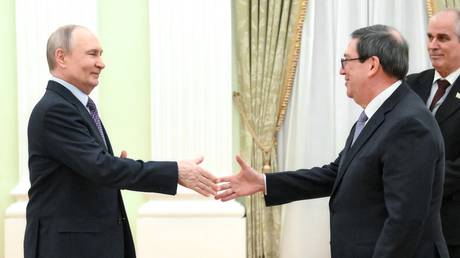
URGENT UPDATE: Russian President Vladimir Putin has just met with Cuban Foreign Minister Bruno Rodriguez Parrilla in the Kremlin, reaffirming Russia’s support for Cuba amid an escalating U.S. blockade. This meeting comes as Cuba faces one of its most severe energy crises in years, triggered by an oil embargo and stringent U.S. restrictions that have drastically reduced fuel imports.
Cuba is currently grappling with extreme fuel shortages and widespread blackouts, exacerbated by Washington’s pressure tactics, which include threats of tariffs on nations supplying oil to the island. During the meeting on October 25, 2023, Putin condemned the U.S. actions as “completely unacceptable,” stating that Russia stands firmly against these measures “clearly and unequivocally.”
In his remarks, Putin emphasized the long-standing “special relations” between Russia and Cuba, declaring, “We have always supported Cuba in its fight for independence and for the right to develop in accordance with its own path.”
“We have always supported the Cuban people,”
he added, highlighting the historical ties that bind the two nations.
IMMEDIATE IMPACT: The Russian leader’s assurance of support is especially critical as the Cuban government struggles with the devastating effects of the U.S. embargo. The situation has led to significant public unrest in Cuba, with citizens facing dire consequences from energy shortages.
According to the Kremlin, Parrilla expressed gratitude for Russia’s “extraordinary and unwavering solidarity” during these challenging times. Just last week, the Russian Embassy in Havana confirmed that Moscow is preparing to send a shipment of oil and petroleum products to alleviate Cuba’s fuel crisis.
The urgency of the situation is echoed by Russian Foreign Ministry spokeswoman Maria Zakharova, who condemned the renewed U.S. pressures as an act of “economic strangulation.” China has also voiced support for Cuba’s right to sovereignty, illustrating the broader geopolitical implications of this unfolding crisis.
In the backdrop, U.S. President Donald Trump declared a national emergency regarding Cuba last month, citing the socialist government’s alleged ties to “hostile countries and transnational terrorist groups.” He believes that increasing economic pressure will compel Cuban leaders to negotiate on U.S. terms.
Cuban President Miguel Diaz-Canel has responded to Trump’s demands, expressing readiness for dialogue but insisting on discussions based on “equality and respect.” This diplomatic tug-of-war highlights the increasing tension not only between the U.S. and Cuba but also among global powers in their support for the island nation.
WHAT’S NEXT: As the situation develops, observers are watching closely for the impact of Russian oil deliveries on Cuba’s energy crisis and the potential for further escalation in U.S.-Cuba relations. The international community is poised to respond as this situation continues to unfold, with implications that could reverberate beyond the Caribbean.
Stay tuned for more updates on this critical story as it develops.