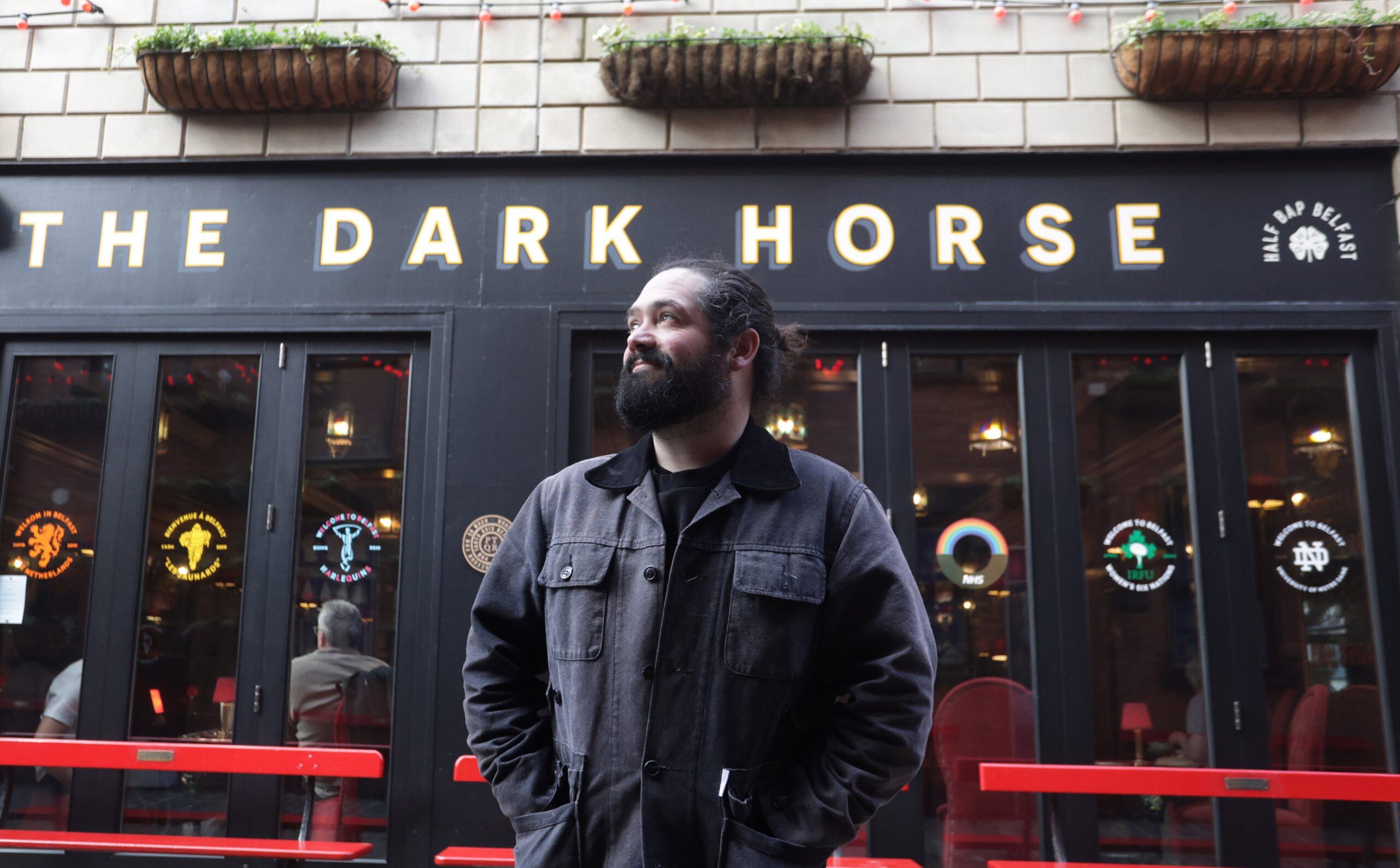
Tony Moore, a graphic designer and lettering artist, is quietly reshaping the visual landscape of Belfast through his hand-painted signs. His work can be found above shopfronts, across museum walls, and in the gleaming gold leaf on glass throughout the city. Moore’s creations, such as the distinctive signage for The Dark Horse and the elegant script framing Pottinger’s Entry, have become integral to Belfast’s identity.
Moore is not one to seek attention for his craft. “I’m not very shouty when it comes to my stuff,” he admits, attributing his willingness to share his story to encouragement from his wife, Sarah. “I’d rather just be doing my job. What we do as sign painters is a pretty quiet job anyway. Less is more and all that.” His passion for lettering began in his teens, inspired by the typography he encountered while skateboarding. “Skateboarding culture is entwined with graffiti and street art, and it just always fascinated me.”
Reflecting on his early influences, Moore recalls his great-grandmother’s tobacco and sweet shop on the Woodstock Road. Family photographs reveal the shopfront adorned with carefully painted lettering. “It was just a newsagent, but someone had taken the time to do it properly. There were no printers or computers involved. It was all done by hand.” He later incorporated the word ‘Moore’ from that shopfront into his logo, honouring a craft that was once prevalent in Belfast.
Moore’s journey into design took several turns. After completing his A levels, he enrolled in art college but soon realised it was not the right fit. Dropping out, he returned to a printing shop where he had previously completed work experience. He eventually re-applied to university to study graphic design, leading to jobs in studios across Newcastle, Dublin, and Belfast. Yet, he felt constrained by the routine. “I was starting to hit a wall,” he admits.
A pivotal moment came when a commission in a Belfast studio highlighted a gap in the market for sign painters. “We were doing work that would have looked really good painted but couldn’t find any sign painters to actually do it. That’s what initially sparked my interest.” He describes this moment as “a bit of a perfect storm.”
As he balanced graphic design work to support himself, Moore began teaching himself sign painting at home. “I’m self-taught for the most part,” he explains, “but in 2015, I found a workshop in London called Better Letters, run by Sam Roberts and Mike Meyer. It just took what I was doing to a completely different level.” In a full-circle moment, he brought Meyer to Belfast last year to conduct a workshop at Vault Artist Studio.
Moore is aware that he is part of a craft that once had a stronger presence in the city. Belfast used to have a dedicated signwriting school, and hand-painted lettering was commonplace. “Technology came in and wiped it out,” he notes, but adds that recent years have seen a resurgence of interest in heritage crafts. “There’s definitely been a resurgence over the last decade thanks to social media and people having a newfound appreciation for heritage crafts.”
His background in graphic design enables him to blend traditional techniques with modern processes. “I’m bridging the gap between the digital and the analogue. It’s more of a hybrid between technology and tradition.” While initially focused on hand-painted signage, Moore has increasingly ventured into bespoke lettering design over the past five years, creating custom letterforms for various applications including print, packaging, and branding.
His commissions span various notable locations in Belfast, including Templemore Baths and popular pubs like The Duke of York and The Watson. Recently, he completed the repainting of the Villa Italia sign in south Belfast. “Getting to work with Villa Italia was class,” he shares. “When I was working in graphic design studios, I’d walk past their sign every day. It’s one of my favourite signs in Belfast, so getting to restore it felt incredible.”
For Moore, this work is about more than aesthetics; it involves a sense of stewardship. He has painted signs on listed buildings and historic sites, fully aware of the trust placed in him. “There’s always that worry. You’re going up the side of a 300-year-old building and thinking, I can’t mess this up,” he reflects.
Despite the pressures of working on significant projects, he finds joy in smaller jobs. “I passed a guy waiting on a bus, and he had a Mike’s Fancy Cheese tote bag with lettering I’d done on it. Those little things are really special.” He strives to create work that resonates with people, though he remains focused on the next project rather than dwelling on past achievements.
Moore views the revival of sign painting as a matter of continuity rather than nostalgia. He notes a growing network of younger signwriters in Ireland, many of whom are self-taught and supportive of one another. “It very much is alive, and we all help each other,” he says. He has mentored students through heritage programmes and facilitated workshops with established practitioners, although he is cautious about overstating his influence.
“I just don’t want it to disappear again,” he states. “It’s the most sympathetic and least intrusive thing you can do to a building. Even when signs get old, they start to look better.” As long as there are walls to paint and letters to shape, Moore intends to keep “colouring them in.” For more information, visit mooreletters.com.