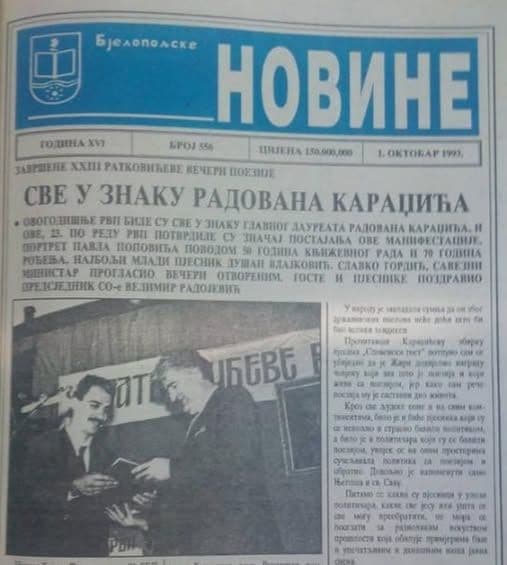
UPDATE: In a historic decision, authorities in Bijelo Polje, Montenegro, have officially removed notorious war criminal Radovan Karadžić‘s name from the list of recipients of the prestigious Risto Ratković Literary Award. This announcement comes 32 years after Karadžić was controversially honored with the award in 1993, a moment now recognized as a significant misstep during the turbulent war years.
The removal of Karadžić’s name was confirmed on November 6, 2025, during a meeting of the JU “Ratkovićeve večeri poezije” council, following a resolution passed by the Bijelo Polje Municipality on October 2, 2025. The council’s unanimous decision marks a symbolic rectification of one of the most contentious cultural choices made during the 1990s conflicts.
Officials stated,
“The council has unanimously rescinded the ‘Risto Ratković’ literary award from Radovan Karadžić, convicted of genocide, crimes against humanity, and violations of the laws and customs of war.”
This significant move comes after months of advocacy from civil society groups and public pressure demanding accountability for past atrocities.
In a deeply emotional context, Karadžić received the award just months after the Shtrpci massacre, where innocent civilians were kidnapped and killed. Among the victims were citizens from Montenegro, highlighting the grave injustices that occurred under his leadership as the then-president of the Republika Srpska and commander of its army.
The decision has been welcomed by numerous human rights organizations, including the Center for Civic Education, Human Rights Action, and the Montenegrin Committee of Lawyers for Human Rights, who played a crucial role in advocating for the award’s revocation. They expressed hope that this decision would send a strong message against glorifying war criminals.
Despite the award being removed from the website in late August, the official acknowledgment of the revocation now completes a long-awaited process that has stirred public discourse for decades. The presence of Karadžić’s name among literary laureates was seen as a blemish not only on the award but on the cultural integrity of Montenegro itself.
During the vote in October, representatives from various political factions, including the Europe Now Movement, the Democrats, and the pro-Serbian Democratic Front, took a stand, with some members leaving the session in protest. This reflects the ongoing political divisions within the country regarding the legacy of the 1990s conflict and the accountability of its leaders.
As the community reflects on this decision, many are reminded of the weight of history and the importance of acknowledging the suffering caused by individuals like Karadžić. Demir Ličina, a representative of the victims’ families, poignantly stated that this decision is not just about one literary award but about respecting the truth and the values upon which society should be built.
The revocation has been hailed as a critical step toward achieving justice for the victims and their families. It is a reminder that while the past cannot be erased, lessons must be learned to prevent history from repeating itself.
This development serves as a clear indication that Montenegro is beginning to confront its past, as the nation grapples with the complex legacy of the 1990s. The decision to strip Karadžić of the award is not merely an act of retribution but rather a necessary acknowledgment of the pain endured by countless individuals during that dark chapter in history.
Going forward, citizens and officials alike will be watching closely for further actions that signal a commitment to truth and reconciliation in Montenegro.