Scientists have identified the source of three enigmatic signals emanating from the centre of the Milky Way, attributing their origin to a specific type of dark matter known as “excited dark matter.” This breakthrough comes after years of research aimed at deciphering the unusual energy spikes that have long puzzled astronomers.
The heart of the Milky Way is a tumultuous environment, characterized by immense gravitational forces and rapid star formation. At its core lies the supermassive black hole, known as Sagittarius A*, which is approximately four million times the mass of the sun. Despite the intense radiation produced in this region, the precise cause of certain gamma-ray emissions has remained elusive.
In a recent study published in The Astrophysical Journal Letters, lead author Dr. Shyam Balaji from King’s College London explained that traditional astrophysical events, such as supernovae, do not adequately account for the specific energy and shape of the signals detected. The researchers propose that excited dark matter could explain at least two, and possibly three, of these unexplained signals.
The signals include a significant spike in gamma-ray radiation at a specific wavelength known as the 511-keV emission line. This phenomenon does not align with conventional theories of matter, prompting scientists to seek alternatives.
Dr. Balaji described excited dark matter as a scenario in which dark matter particles temporarily transition to a higher-energy state upon colliding with one another. When these particles revert to their normal state, they release energy by generating an electron and its antimatter counterpart, a positron. The positrons produced in this process are detectable by advanced telescopes such as the European Space Agency’s INTEGRAL mission, which operates at an altitude of approximately 37,000 miles (60,000 kilometers) beyond Earth’s radiation belts.
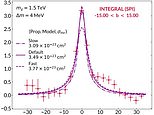
By analyzing data from the INTEGRAL mission and comparing it to theoretical models of positron behavior, researchers found that collisions among the positrons generated by excited dark matter could lead to the observed spike in gamma-ray radiation corresponding to the 511-keV emission line.
Furthermore, the excited dark matter model may explain additional anomalies, including a high-energy light source identified as the 2 MeV gamma-ray continuum. Dr. Balaji noted that this signal necessitates positrons with energies of only a few million electron volts, a range not typically produced by other astrophysical sources.
The investigation into dark matter’s role does not stop there. The research team suggests that excited dark matter could also account for an unusually high level of ionization in a dense gas region known as the Central Molecular Zone (CMZ), located approximately 28,000 light-years from Earth. The CMZ contains nearly 80 percent of the galaxy’s dense gas, and its ionization levels have not been satisfactorily explained by known cosmic rays or other phenomena.
Co-author Damon Cleaver, a PhD student at King’s College London, remarked on the significance of their findings. He stated, “If one mechanism could account for several long-standing unexplained observations in space, it provides a clearer direction for future research.” He expressed hope that upcoming space missions might enable scientists to further investigate whether dark matter is responsible for some of the Milky Way’s most enduring mysteries.
Dark matter remains one of the universe’s greatest enigmas, thought to constitute around 27 percent of the cosmos, yet it has never been directly observed. The European Space Agency explains the challenge of studying dark matter by likening it to shining a torch in a dark room; while the light reveals only a small portion of the space, the surrounding room still exists. The gravitational effects of dark matter on visible matter provide indirect evidence of its presence.
As research continues, the discoveries surrounding excited dark matter may not only illuminate the source of the Milky Way’s mysterious signals but could also enhance our understanding of the universe’s composition and the fundamental forces at play.