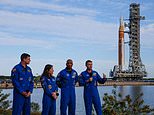
NASA has made significant strides towards its historic Artemis II mission by delivering the rocket to the launch pad at the Kennedy Space Center in Cape Canaveral, Florida. This marks the first manned lunar expedition in over 50 years, with a planned launch date as early as February 6, 2026. The mission will be the first to orbit the moon since Apollo 17 in 1972, paving the way for future lunar exploration.
The Artemis II rocket, which comprises the Space Launch System (SLS) and the Orion spacecraft, was transported on the crawler-transporter 2 vehicle along a four-mile route to the launch pad. The journey took approximately 12 hours. Following its arrival, engineers will prepare the rocket and spacecraft for a rehearsal test that includes loading propellants.
NASA Administrator Jared Isaacman emphasized the mission’s importance, stating it fulfills a commitment to the public to return to the moon. He described the endeavor as a critical step toward broader space exploration goals.
Assembling the Crew for Lunar Exploration
The Artemis II mission will feature a crew of four, including three NASA astronauts: Christina Koch, Victor Glover, and Reid Wiseman, alongside Jeremy Hansen from the Canadian Space Agency. Wiseman will command the mission, which is poised to demonstrate new capabilities in space travel.
Hansen expressed that this mission is “good for humanity,” acknowledging a newfound appreciation for the moon. He remarked, “I think others are going to join us in staring at the moon a lot more as there are humans flying around the far side.”
Koch highlighted the need for adaptability among astronauts, noting that none of them have previously traveled to the moon. “The most important thing is that you’re ready to take on what you haven’t prepared for,” she stated.
Scientific and Strategic Implications of Artemis II
The Artemis program aims to explore the moon for scientific discovery and economic benefits while laying the groundwork for potential crewed missions to Mars. Isaacman referred to the moon as a “perfect proving ground” for testing autonomous capabilities in spacecraft. He suggested that initial lunar bases may not resemble futuristic cities but would likely include autonomous rovers engaged in tasks such as mineral extraction.
As the mission progresses, the Orion spacecraft will eventually splash down in the Pacific Ocean, where recovery operations will be conducted with support from the U.S. Navy.
The Artemis II mission represents a pivotal moment in space exploration, seeking to inspire future generations and expand human presence beyond Earth. NASA’s commitment to returning to the moon underscores the potential for scientific breakthroughs and the advancement of interplanetary exploration.