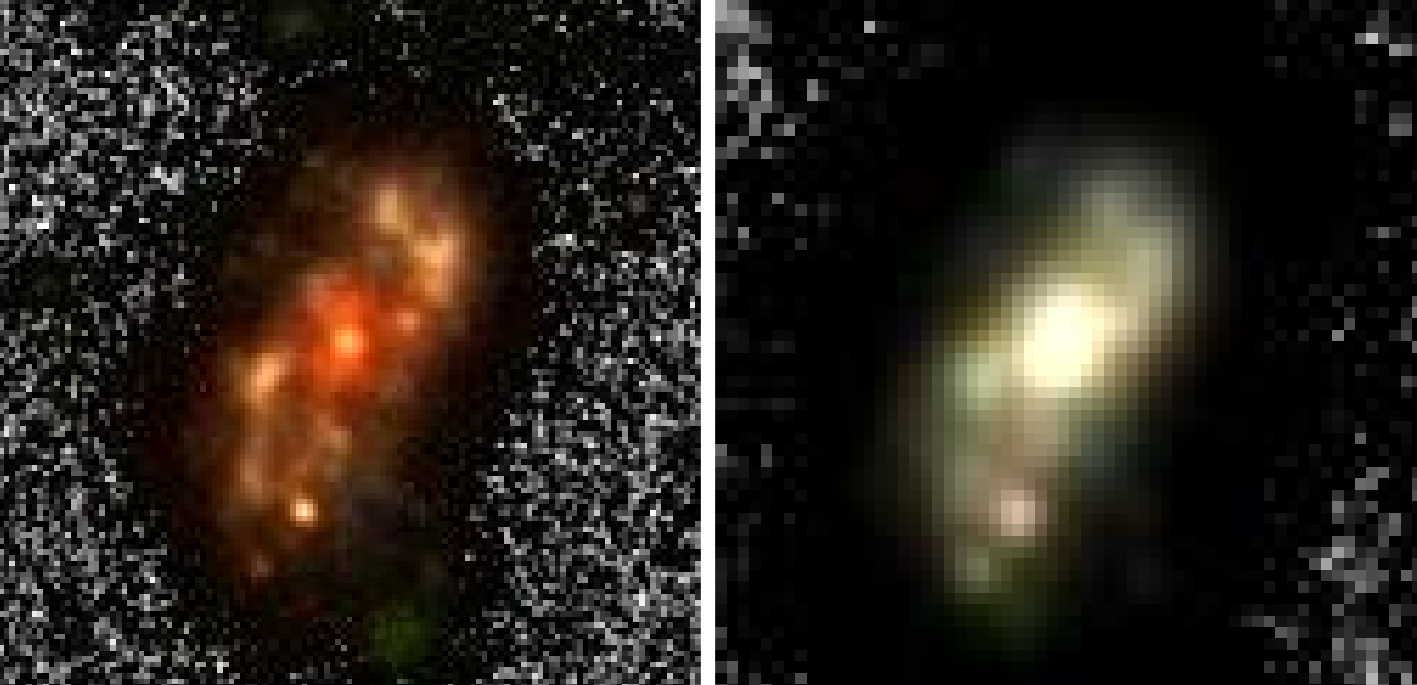
Scientists have uncovered a remarkable spiral galaxy, named Alaknanda, located approximately 12 billion light-years from Earth. This galaxy formed shortly after the Big Bang, when the universe was just around 1.5 billion years old, as revealed by data from NASA’s James Webb Space Telescope. Alaknanda’s discovery challenges long-held beliefs regarding the structure of early galaxies.
For many years, astronomers maintained that galaxies in the early universe were too chaotic to develop the organized spiral shapes observed in modern galaxies. Previous findings from the Hubble Space Telescope indicated that such structures became increasingly rare more than 11 billion years ago. Alaknanda’s existence raises significant questions about how galaxies managed to form and organize themselves so rapidly in the early cosmos.
Yogesh Wadadekar, co-author of the study, stated, “Alaknanda reveals that the early universe was capable of far more rapid galaxy assembly than we anticipated.” He emphasized that this galaxy successfully accumulated 10 billion solar masses of stars into a well-defined spiral disk in a mere few hundred million years—an extraordinary feat by cosmic standards.
Details of the Discovery
The research team, affiliated with the Tata Institute of Fundamental Research in India, published their findings in the journal Astronomy & Astrophysics. The observations were enhanced by a natural phenomenon known as gravitational lensing. This occurs when the gravity of a massive galaxy cluster amplifies the light of Alaknanda, allowing scientists to observe it with unprecedented clarity.
In their analysis, researchers found that Alaknanda spans about 32,000 light-years across, making it comparable to large spiral galaxies present today. Its structure features two prominent spiral arms that exhibit a classic pinwheel shape. The arms are smooth and symmetrical, which categorize Alaknanda as a “grand-design” spiral galaxy, rather than one with fragmented or irregular features.
Images of Alaknanda showcase chains of luminous clumps of newborn stars along its spiral arms. These bright regions indicate areas where gas has collapsed into dense pockets, igniting new star formation. Observations across various wavelengths of light revealed that the stars in Alaknanda are, on average, only about 200 million years old, with many forming in a swift burst after the universe reached the age of one billion years.
Implications for Galaxy Formation Theories
Alaknanda continues to actively form stars at an impressive rate, producing new stars equivalent to approximately 63 suns per year, significantly outpacing the Milky Way’s current star formation rate. Certain wavelengths of light emitted from Alaknanda shine brighter than expected, corroborating its vigorous star-forming activity.
The rapid formation of spiral arms in ancient galaxies like Alaknanda remains a topic of debate among astronomers. Some theories suggest that these structures emerge from slow-moving density patterns within the galaxy’s disk, while others propose that gravitational interactions with nearby galaxies or large gas clumps could play a role. Evidence suggests that Alaknanda might have a small neighboring galaxy that could have influenced its spiral formation, although further research is necessary to confirm this.
Future observations utilizing Webb’s advanced instruments, along with data from radio telescopes, aim to map the motions of Alaknanda’s stars and gas. Such studies could clarify whether its disk has reached a stable configuration or if the spiral arms represent a transitional phase in its evolutionary path.
As astronomers continue to study Alaknanda and similar galaxies, these discoveries are expected to reshape our understanding of galaxy formation in the early universe, offering insights into the complex processes that governed the cosmos shortly after its inception.