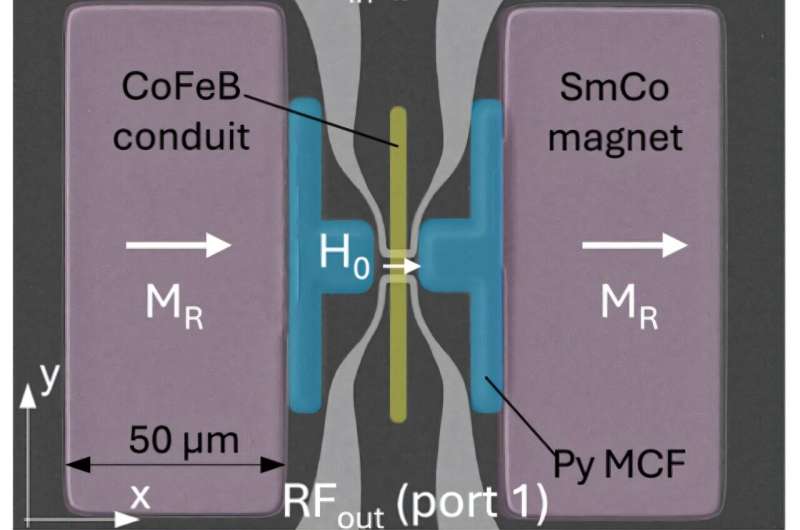
The Politecnico di Milano has developed the world’s first integrated spin-wave chip that operates without external magnets, a significant advancement for future telecommunications. This innovation opens new possibilities for communication technologies, extending beyond current standards such as 5G and 6G. The study detailing this breakthrough was published in the journal Advanced Materials on January 13, 2026 and involved collaboration from experts at Rheinland-Pfälzische Technische Universität and Istituto Officina dei Materiali—CNR-IOM.
This pioneering device utilizes spin waves, which are collective excitations of electronic spins in magnetic materials. Traditionally, the application of spin waves was limited by the necessity for an external magnetic field, hindering their integration into chips. The new spin-wave chip from Politecnico di Milano addresses this limitation by employing an innovative combination of permanent SmCo micromagnets and magnetic flux concentrators, allowing the device to function independently.
Technical Specifications and Functionality
Measuring just 100 × 150 square micrometers, the chip is significantly smaller than existing radiofrequency signal processing devices that rely on acoustic waves. It is fully integrated on silicon, ensuring compatibility with current electronic platforms. The design includes a spin wave guide made of CoFeB and features two antennas for RF signal input and output.
The device can modulate the transverse magnetic field with remarkable precision, adjusting the distance between magnets and concentrators to between 11 and 20.5 mT. This precision enables the adjustment of operating frequencies between 3 and 8 GHz, and tuning the phase shift up to 120 degrees at 6 GHz. Notably, the prototypes are already functioning as time delay lines and phase shifters without the need for an external bias field.
Future Implications and Market Potential
The researchers indicate that the integration of this technology with Micro-Electro-Mechanical Systems (MEMS) could allow for real-time reconfiguration of the devices. The choice of SmCo micromagnets guarantees stability at temperatures up to 200°C while generating magnetic fields without consuming energy.
According to Riccardo Bertacco, head of the Department of Physics at Politecnico di Milano, “This result is a decisive step towards moving spin waves from demonstrations in the lab towards a technology that can actually be incorporated into telecommunication systems and electronic circuits.” Silvia Tacchi from CNR-IOM echoed this sentiment, stating, “This finding represents a key advancement in the field of magnonics, bringing spin-wave chips closer to being integrated into electronic devices.”
The development of this chip is part of the MandMEMS project. Project coordinator Philipp Pirro from RPTU views this achievement as a milestone on the project roadmap, stating, “Building on this milestone, we can now tackle the next challenges, such as further increasing the transmission efficiency of the devices. Based on the large improvements achieved to date, we are confident to present soon marketable devices for 6G which are based on standalone spin-wave chips.”
The consortium behind this project includes a range of European research centers and industrial partners, possessing expertise in magnonics, MEMS, RF electronics, and materials science. Their collective aim is to develop a technological platform that enhances the efficiency, compactness, and reconfigurability of future communication devices.
With this breakthrough, the Politecnico di Milano, Rheinland-Pfälzische Technische Universität, and Istituto Officina dei Materiali—CNR-IOM have laid the groundwork for compact, low-power, high-performance devices. The potential repercussions extend not only to future telecommunications but also to consumer electronics, the automotive sector, diagnostics, and various applications requiring integrated processing of high-frequency signals.