A team from Vodafone has achieved a significant milestone in telecommunications, successfully conducting the world’s first video call from space using a standard mobile phone. This groundbreaking event occurred on January 29, 2025, and was facilitated by an innovative setup in a car park at Vodafone’s Newbury office. The development promises to enhance mobile connectivity across the UK, potentially eliminating dead zones.
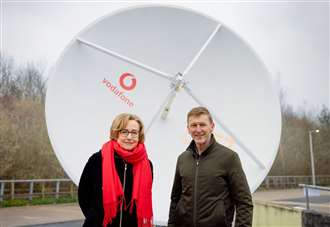
The project began in December 2024, presenting a logistical challenge: the installation of a satellite dish weighing one tonne and measuring 2.4 meters in diameter. The dish required an unobstructed view of the sky to track fast-moving satellites. After assessing multiple locations, the team decided on the top deck of the office car park at The Connection in Newbury. A week-long delay ensued while awaiting a plane capable of transporting the dish from Europe, complicating the timeline further.
Upon arrival, the team faced additional challenges. Due to height restrictions, traditional equipment such as cranes and forklifts were not feasible. According to Vodafone engineer Sami Gabriel, who resides in Newbury, the assembly involved around ten team members working together to tackle the unique obstacles. “In the R&D team, we do a lot of trials so it’s a matter of finding a way to make it happen – no is not an acceptable answer,” Gabriel remarked.
To power the satellite dish, the engineers had to run a 100-meter extension cord from the main building, as the car park could only supply enough electricity for lighting. While half of the team focused on constructing the communication gateway, the other half was tasked with finding a location devoid of mobile signal—referred to as a ‘not-spot.’
Lead engineer Rowan Chesmer, along with his colleague Abdirahman Farrah and Chesmer’s dog, Odin, ventured into the remote valleys of Wales. They faced severe winter conditions, including snow-covered paths and flooded roads, in their quest to identify the ideal location for testing the technology. “You can’t see anything, but you hold a spectrum analyser up and you can clearly see the signal,” Chesmer explained. “It looks really boring when you’re doing it, but it’s incredibly exciting when there’s something there.”
Back in Newbury, anticipation ran high. The team had limited time, as satellites move quickly, creating narrow windows of opportunity—approximately ten to twenty minutes—to test the call before the satellite moved out of range. Chesmer noted, “There was a running bet as to which satellite would make the first call.”
At dawn on January 29, the team successfully initiated a voice call, followed by a historic video call to Vodafone CEO Margherita Della Valle. Unlike standard mobile phones that rely on masts located around four kilometers away, this technology connects via satellites positioned over 500 kilometers in space. With no obstructions in orbit, the signal remains robust and reliable.
Following the successful demonstration, the temporary setup in the Newbury car park has been relocated to a more permanent site. Vodafone has announced plans to launch commercial services by late 2026, which will deliver 4G and 5G coverage in remote areas, significantly improving connectivity for users in the most isolated locations.
This achievement marks a pivotal advancement in mobile communication, showcasing the potential for satellite technology to bridge gaps in connectivity and enhance user experience across the globe.