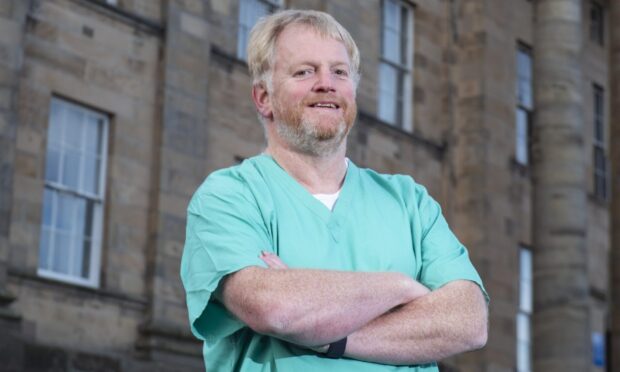
Dr. Struan Wilkie, a consultant radiologist at Dr Gray’s Hospital in Elgin, is at the forefront of a significant advancement in lung cancer detection through the use of artificial intelligence (AI). His innovative approach is aiding NHS Grampian in identifying lung cancer earlier, which is crucial given that lung cancer remains the leading cause of cancer death in Scotland.
Wilkie’s journey into medicine was inspired by a seemingly simple introduction to computing back in the 1980s. He recalls the BBC Micro, a personal computer that stimulated his interest in technology. “I’ve always had an interest in computing, and that’s probably why I wanted to merge the medical and computing sides together to make people’s lives better,” he explained.
Transforming Radiology with AI
Every year, the radiology teams in Grampian review approximately 70,000 chest X-rays, translating to about 300 X-rays a day. Detecting lung cancer through these images can often be challenging, as symptoms tend to be vague or attributed to other conditions. “It’s often a hidden killer,” Wilkie noted. Many patients receive a chest X-ray for unrelated issues, which is when the cancer can sometimes be detected.
To tackle this challenge, Wilkie and his colleagues have integrated AI technology into their workflow. This system prioritizes chest X-rays that exhibit concerning signs, thereby expediting the reporting time for urgent suspected cases of cancer to within 24 hours. This initiative significantly reduces delays at the onset of the diagnostic process, improving the chances of effective treatment.
Wilkie emphasized the importance of early detection, stating, “The earlier you find it, the more options there are for treatment.” By harnessing AI, NHS Grampian is not only shortening waiting times but also alleviating the pressure on radiology teams, ultimately leading to better patient outcomes.
Addressing Concerns about AI Integration
The implementation of AI in a clinical setting was not without its challenges. Transitioning from research trials to everyday practice took more than a year, requiring the alignment of various IT systems and collaboration among different organizations. “There were governance checks, IT systems to align, and organisations that had never worked together before needing to talk to each other,” Wilkie explained.
Additionally, there were concerns among staff regarding the impact of AI on their roles. Wilkie believes that perceptions are shifting. “I think we have moved away from the ‘Oh, you’re replacing us all’,” he noted. Instead, he views AI as a tool designed to assist medical professionals, stating, “At no point is the AI running autonomously. It’s a prioritization tool — a way of making sure the patients who need attention most urgently are seen first.”
Wilkie likened the current evolution in radiology driven by AI to the historical shift from X-ray to computed tomography (CT). This transition helped establish Aberdeen Royal Infirmary as one of Scotland’s leading centers for advanced imaging. He is optimistic about AI’s potential to enhance healthcare delivery and address future challenges facing the NHS.
Reflecting on his early fascination with computers, Wilkie acknowledges how far he has come since those days in the classroom. He maintains a connection to his childhood interests, sharing a light-hearted moment about enjoying retro video games, albeit with an awareness of their increasing value. “That was until my wife found out how much they were worth and nearly fell off her chair,” he added with a smile.
Through his innovative work, Dr. Struan Wilkie is not only advancing medical technology but also shaping the future of patient care in Scotland, ensuring that early detection of lung cancer becomes a reality for more patients.