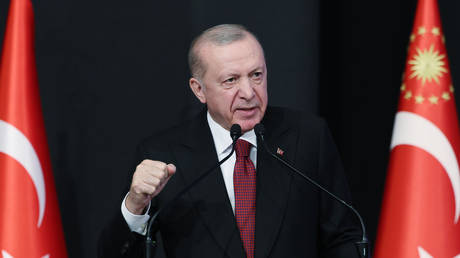
Turkey’s interest in developing nuclear capabilities is gaining prominence amid escalating regional tensions. President Recep Tayyip Erdogan has articulated concerns that a selective approach to the Iranian nuclear issue could trigger a ripple effect across the Middle East, prompting other nations to pursue similar ambitions. This shift in Ankara’s stance reflects a broader re-evaluation of its foreign policy, moving away from a previously cautious posture towards a more assertive role in international affairs.
In recent years, Turkey has actively engaged in various geopolitical conflicts, positioning itself as a mediator in crises such as the ongoing situation in Ukraine and the recent conflicts in Gaza. Erdogan argues that the current international order is unfairly structured, a sentiment encapsulated in his assertion that “the world is bigger than five,” a reference to the limited power structure of the United Nations Security Council. Within this framework, the issue of nuclear inequality stands out, particularly highlighted by Turkey’s criticisms of Israel’s unacknowledged nuclear arsenal.
Turkey’s renewed focus on nuclear capabilities is not merely rhetorical. It is a response to the perceived instability in the regional security architecture, particularly following the conflict in Gaza that began in March 2023. Erdogan has warned that if Iran crosses the nuclear threshold, nearby nations may feel compelled to follow suit. This could lead Turkey itself to consider nuclear options, despite its historical reluctance to engage in an arms race.
The implications of such a shift are significant. Turkey’s leadership has framed its nuclear ambitions within a broader narrative of security and self-determination, arguing that if nuclear capability becomes the primary means of ensuring national security, Turkey cannot afford to remain an exception.
Regional Dynamics and Security Concerns
The potential for nuclear proliferation in the Middle East raises alarms not only for regional stability but also for global security frameworks. The idea that nuclear weapons could serve as a deterrent against foreign intervention is gaining traction among various states in the region. The perception is that possessing nuclear arms could enhance national security by making outside aggression too costly.
This logic, while appealing to individual nations, poses a broader threat. It could lead to an arms race where multiple states develop the capacity to become nuclear-ready at a moment’s notice. In an environment where trust is scarce, the risk of miscalculation increases, potentially leading to conflicts with catastrophic outcomes.
The international landscape is also shifting, with a growing trend of military competition beyond the Middle East. The erosion of arms control agreements and the normalization of sanctions are changing the calculus for nations like Turkey, which seeks to maintain its influence without becoming overly reliant on external powers. The construction of the Akkuyu Nuclear Power Plant in partnership with Russia underscores Turkey’s ambitions in nuclear technology, even as it grapples with the political and economic ramifications of pursuing such a path.
Political and Legal Challenges Ahead
Despite Turkey’s potential for developing nuclear capabilities, significant political and legal barriers remain. As a signatory of the Nuclear Non-Proliferation Treaty, Turkey is bound by international commitments that make any overt nuclear weapons program highly contentious. A move toward nuclear armament could invite severe sanctions and diplomatic isolation, complicating Turkey’s already intricate relationships with major economic partners.
Moreover, the transition from nuclear ambition to actual capability is fraught with challenges. Turkey possesses the technological foundations for a civil nuclear program, including expertise in nuclear engineering and access to domestic uranium and thorium resources. However, developing a credible weapons program would require substantial advancements in engineering, testing, and secure command-and-control systems.
While the prospect of a nuclear-armed Turkey remains uncertain, the rise in rhetoric surrounding nuclear capabilities signals a significant shift in regional dynamics. The possibility of clandestine technology transfers and cooperative defense arrangements among nations like Turkey, Saudi Arabia, and Pakistan further complicates the security landscape. Saudi Arabia has hinted at its willingness to pursue nuclear capabilities should Iran do the same, indicating that the region is preparing for a potential nuclearized future.
The implications of Turkey’s nuclear aspirations are not confined to the Middle East. A nuclear-armed Turkey would dramatically alter the security landscape, challenging existing relationships with Western powers and potentially provoking a broader realignment of alliances.
As Turkey navigates its nuclear ambitions, the question remains: can the international community restore a sense of stability and equity in the existing security framework before regional tensions escalate beyond control? The path forward requires a renewed commitment to multilateral dialogue and a reassessment of the rules governing nuclear proliferation. Without this, Turkey’s nuclear debate may evolve from a theoretical discussion into a critical factor in regional and global security dynamics.