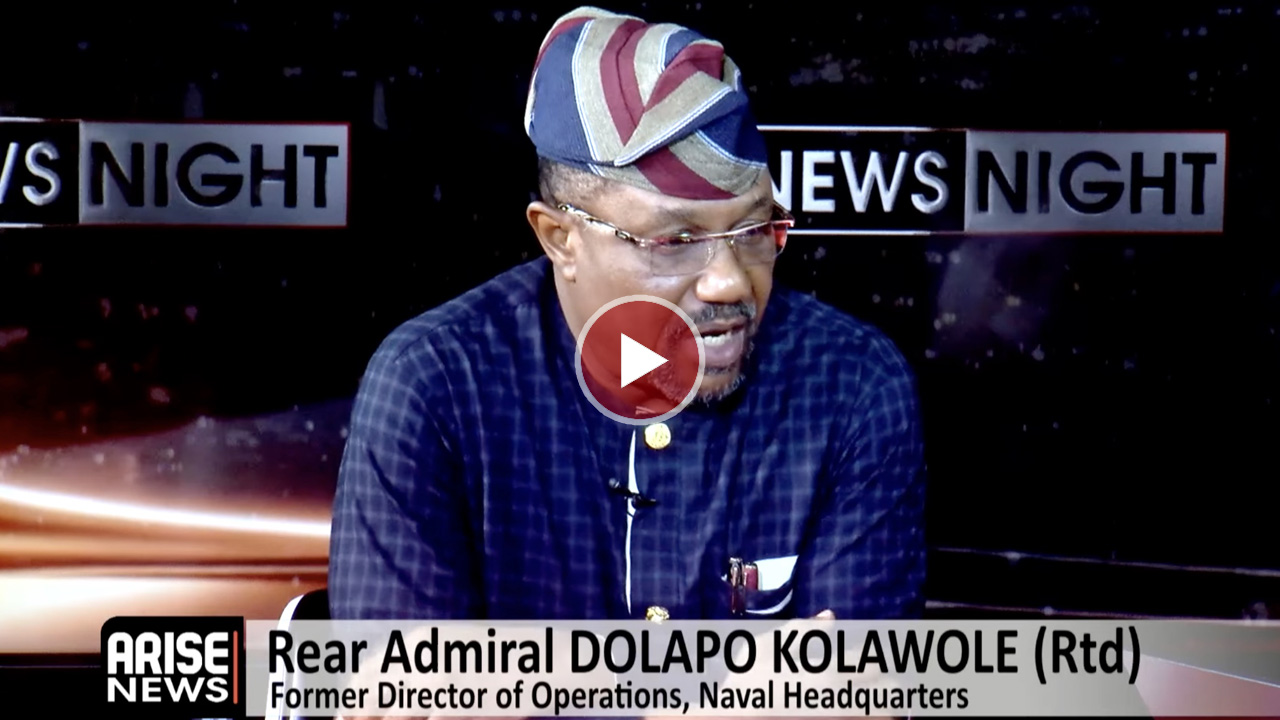
Rear Admiral Dolapo Kolawole, a retired senior officer and former Director of Operations at the Naval Headquarters, has highlighted the critical role of intelligence in combating Nigeria’s ongoing security challenges. He asserts that the country’s persistent violence and mass killings stem from failures in actionable intelligence rather than a deficiency in military capabilities.
In an interview with ARISE News on March 15, 2024, Kolawole responded to the recent deployment of a small contingent of United States troops to Nigeria and the alarming increase in violent incidents across the nation. These include attacks resulting in casualties among both security personnel and civilians, particularly in Benue State and reports of significant loss of life in Kwara State.
Kolawole commenced the discussion by praising the Nigerian armed forces, especially the Navy, which has recently been recognized as the strongest in Africa. “First of all, let me congratulate the federal government, the Nigerian people, and the armed forces of Nigeria on the current global power rating of the Nigerian Navy as the most powerful in Africa,” he stated. He attributed this ranking to the extensive naval assets at Nigeria’s disposal, boasting a fleet of 152 platforms, surpassing other African navies, including those of Arab nations and South Africa.
He emphasized that the Nigerian Navy’s fleet is well-suited to address the country’s security needs and regional responsibilities. “Our current fleet is very much aligned with Nigeria’s threat perception and our global ambitions,” Kolawole added.
Addressing the issue of resurging terrorist activities, he pointed out that the Navy is equipped with specialized capabilities for asymmetric warfare. “The Nigerian Navy has a component that can be deployed for asymmetric warfare,” he explained, referring to the Nigerian Navy Special Boat Service, which he commanded in the past. Modeled after the United States Navy SEALs, this unit is trained for complex counterterrorism operations both on land and at sea.
Despite the Navy’s capabilities, Kolawole stressed that military hardware alone would not suffice to halt the violence. He argued that intelligence gaps represent the most significant hurdle in addressing terrorism. “When you talk about terrorism and militancy, the most vital component is intelligence,” he remarked. He elaborated on how terrorists exploit these intelligence weaknesses to act without detection, stating, “They can operate where they want, how they want, when they want, without me knowing.”
To combat this, Kolawole called for enhanced intelligence capacity, particularly through human intelligence and infiltration of terrorist organizations. “A basic way out is human intelligence, infiltration with moles,” he said, urging the Department of State Services, the Armed Forces Intelligence, and the Defence Intelligence Agency to penetrate these groups effectively.
On the matter of maritime security, Kolawole dismissed claims that piracy and oil theft undermine the Navy’s high global ranking. He noted that while these issues persist, there has been a significant reduction in their prevalence. “Even with the most effective militaries or policing units, it is difficult to have a completely crime-free environment,” he acknowledged.
He explained Nigeria’s approach to maritime security as a collaborative effort involving the government, the Navy, and local communities. This “tripod” model has facilitated a more effective security architecture, reducing conflicts between security forces and host communities. “It has eliminated constant conflict and clashes to an extent,” Kolawole noted.
He urged private maritime security firms to cooperate more closely with the Navy. “These companies need to embrace the Nigerian Navy and see it as a partner rather than a rival,” he stated, indicating that rivalry has led to tension that could be resolved through better collaboration.
Kolawole also addressed the confirmed presence of US troops in Nigeria, suggesting that it signifies a deeper military partnership. He emphasized the necessity for clarity from Nigerian authorities regarding the mission and operations of these troops. “Nigerians deserve transparency on the deployment,” he insisted, calling for the Minister of Defence to provide detailed information about the presence and objectives of the US personnel.
In conclusion, Kolawole underscored the importance of intelligence in shaping effective counterterrorism strategies. He believes that with improved intelligence capabilities, Nigeria can not only anticipate terrorist actions but effectively disrupt their operations and dismantle their networks.