Sir Keir Starmer will address Members of Parliament on the ongoing conflict in Iran, following sharp criticism from Donald Trump. The US President declared that Starmer is “not Winston Churchill” in response to the Prime Minister’s refusal to allow American planes to launch strikes against Iran from British bases. This criticism adds fuel to the political fire surrounding the UK’s role in the crisis.
On Tuesday, Starmer announced that the UK would deploy HMS Dragon, one of the Royal Navy’s six Type 45 air defence destroyers, to defend Cyprus after RAF Akrotiri was targeted by a drone attack. The conflict, now in its fifth day, is expected to dominate discussions when Starmer appears in the Commons for Prime Minister’s Questions on Wednesday at noon.
Trump expressed dissatisfaction with the UK’s decisions regarding military cooperation, stating during a press conference in the Oval Office, “This is not Winston Churchill that we’re dealing with.” Despite the US president’s remarks, Downing Street has maintained that the United Kingdom remains a “staunch” ally of the United States, emphasizing the importance of their partnership.
Starmer’s decision on Sunday allowed the use of UK bases, including the joint UK-US site at Diego Garcia in the Chagos Islands and RAF Fairford in Gloucestershire, but only for defensive purposes aimed at protecting nations targeted by Tehran. The HMS Dragon is currently being prepared for deployment to the Mediterranean and will be supported by two Wildcat helicopters equipped with “drone busting” Martlet missiles to safeguard British installations in Cyprus.
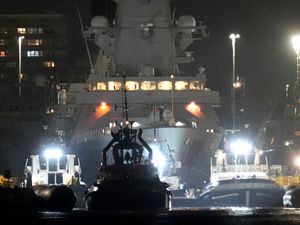
The warship, adorned with the Welsh red dragon on its prow, was photographed on Tuesday night at the Upper Harbour Ammunition Facility in Portsmouth. Meanwhile, Foreign Secretary Yvette Cooper confirmed that a government charter flight will soon depart from Muscat, Oman, to assist vulnerable British nationals in returning home. Approximately 130,000 British citizens have registered their presence in the Middle East, prompting evacuation preparations.
While a few commercial flights are bringing some stranded Britons back, a majority of departures from the region have been halted due to widespread airspace closures. The conflict escalated following the killing of Iranian supreme leader Ayatollah Ali Khamenei on Saturday, prompting Iran and its allies to retaliate against Israel, Gulf states, and oil and gas production sites.
In a further escalation of the situation, Trump indicated that the US military might begin escorting oil tankers through the narrow Strait of Hormuz to protect them from Iranian attacks and to help stabilize rising energy prices resulting from the ongoing war. The international community watches closely as the situation develops, with significant implications for regional stability and global energy markets.