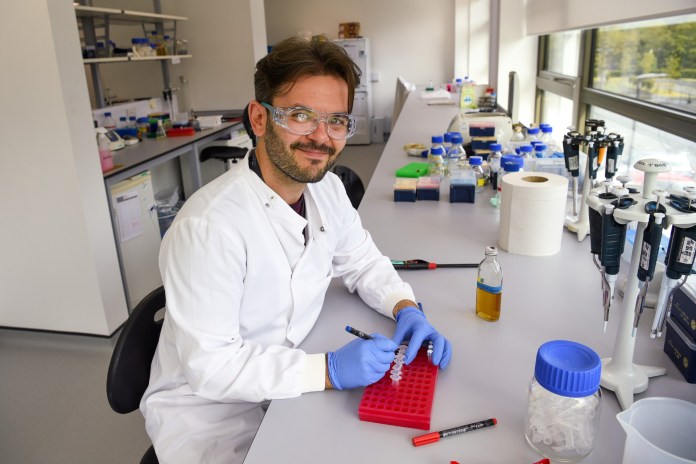
A dedicated scientist has successfully transformed his apprenticeship into a PhD, exemplifying the potential of work-based learning. Jack Kay, now a senior scientist in molecular biology at Ingenza, completed his doctorate while juggling full-time work. His journey unfolds during Scottish Apprenticeship Week, highlighting the value of apprenticeships in the biotechnology sector.
Kay began his career at Ingenza in 2012 after reaching out to the firm for work experience. Unsure about pursuing a traditional university education, he was offered an apprenticeship that allowed him to earn a salary while gaining practical qualifications. During this period, he completed a Higher National Diploma (HND) in chemical sciences at Forth Valley College, balancing lab work with his studies.
Keen to advance further, Kay secured direct entry into the third year of a chemistry program at Heriot-Watt University, focusing on medicinal and pharmaceutical chemistry. He maintained his work-study balance, which provided him with a robust foundation for future studies. Following this, he pursued a PhD in protein engineering at the University of Plymouth, guided by Professor Mat Upton. His research aimed at engineering microbial proteins to address drug-resistant infections.
This doctoral work was supported by Ingenza and backed by an Industrial Fellowship from the Royal Commission for the Exhibition of 1851, a prestigious award given to only 10 to 15 candidates each year. Throughout his academic advancement, Kay remained with Ingenza, ensuring that his research aligned closely with real-world industrial projects. He also benefited from the Industrial Biotechnology Innovation Centre (IBioIC) doctoral training program, which provided access to specialized sessions and networking opportunities in the biotechnology community.
Today, Kay specializes in recombinant protein expression and purification, protein engineering, and the application of artificial intelligence (AI) and machine learning in biotechnology. He actively supports master’s students through IBioIC, contributing to the development of the next generation in the field.
Reflecting on his journey, Kay stated, “University didn’t feel like the right fit for me when I was coming to the end of secondary school. I’m a hands-on learner and I wanted to be in a working lab from the start, so the apprenticeship meant I could earn a wage, gain experience, and build qualifications at the same time. It’s been a long road, but it’s given me real depth of experience. Being able to apply what I was learning straight away in a commercial setting made a huge difference, and now, supporting master’s students, it really does feel like things have come full circle.”
As of December 2025, nearly 40,000 modern apprentices are in training across Scotland. Ingenza stands out as one of the few biosciences small and medium-sized enterprises (SMEs) offering pathways from apprenticeship to doctoral-level study.
Dr. Mary Doherty, skills program manager at IBioIC, emphasized the importance of flexible, work-based routes into science and biotechnology. “Jack’s path shows the power of these opportunities. As we mark Scottish Apprenticeship Week, it’s important to recognize that apprenticeships can open doors all the way through to doctoral-level research and highly skilled careers. Strong partnerships between companies, colleges, and universities are key to making that happen,” she stated.
This inspiring story not only illustrates the potential of apprenticeships in academic and professional advancement but also highlights the importance of industry collaboration in fostering talent within the biotechnology sector.