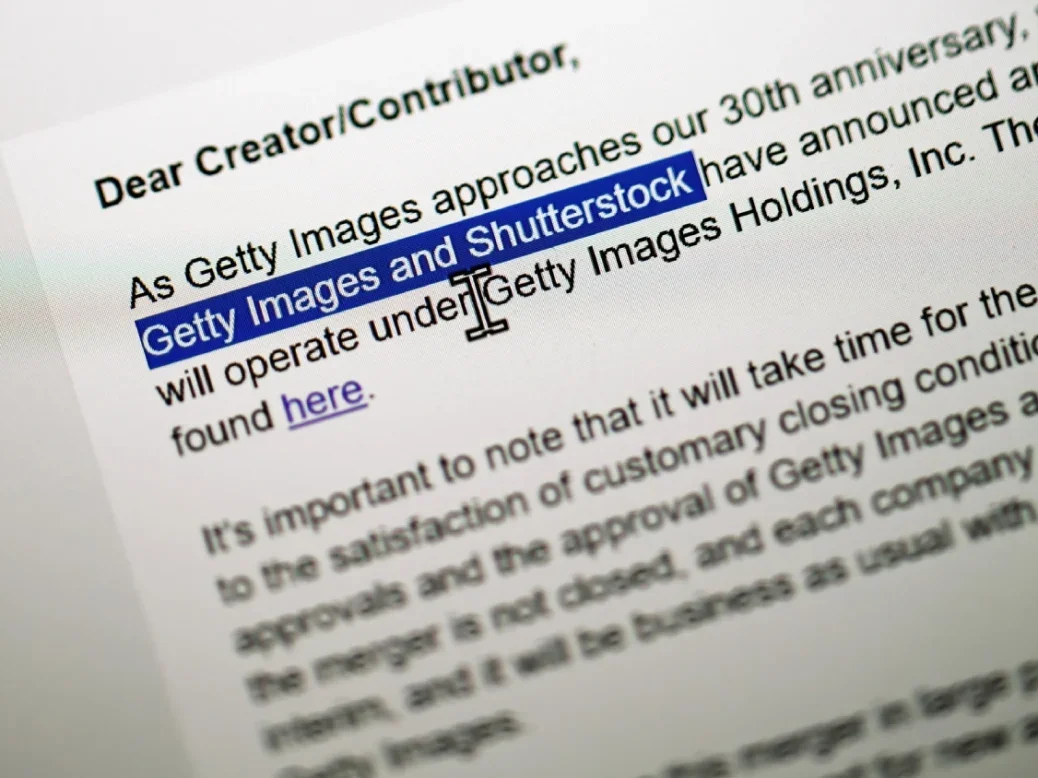
The proposed merger between image providers Getty Images and Shutterstock, valued at $3.7 billion, could significantly reduce competition in the UK editorial market, according to the UK Competition and Markets Authority (CMA). This warning highlights concerns over the availability of time-sensitive imagery from major news events, celebrity appearances, and sporting occasions.
In its interim report released on March 12, 2024, the CMA stated that the merger might lead to a “substantial lessening of competition” specifically within the editorial content sector. The report emphasizes that this could adversely affect media outlets, publishers, and filmmakers who rely on diverse and timely visual content to engage audiences.
While the CMA’s report raises alarms about the editorial market, it found no issues regarding the global supply of stock images licensed for commercial use. This is attributed to the emergence of generative AI technology, which enables the production of stock imagery, and the presence of significant competitors such as Adobe and Canva.
The CMA has invited public comments on its findings as it prepares for a final ruling concerning the merger. Both Getty and Shutterstock, which are publicly traded in the United States but maintain substantial operations in the UK, announced their plans to merge in January 2025. Their joint statement suggested that the merger would create a larger content library, offer more opportunities for contributors, and allow for increased investment in innovation, particularly in generative AI.
Concerns remain that this merger might lead to higher subscription costs for UK news organizations. The CMA identified Getty as the dominant player in the UK market for editorial content, noting its strong offerings in archive, entertainment, news, and sports imagery. The merger with Shutterstock, which competes closely with Getty, could result in the combined entity controlling “close to or above” half of the UK market.
The CMA’s analysis pointed out the high barriers to entry and expansion in this sector, indicating a lack of evidence for potential new competitors entering the market in the near future. Among the rivals mentioned are newswires such as PA Media Group, the Associated Press, and Reuters, alongside entertainment providers like Splash and Backgrid.
Margot Daly, chair of the panel leading the CMA investigation, expressed the potential implications for customers, stating, “Editorial images—covering everything from red carpet events to major breaking news—are crucial for media outlets. Any loss of competition could have a strong impact on these customers.” She also noted that the findings suggest the merger could yield negative outcomes for consumers of Getty and Shutterstock’s editorial offerings in the UK.
In response, Getty expressed satisfaction that the merger is not expected to create competition issues in the global stock content market, but it disagrees with the CMA’s concerns regarding the editorial sector. Craig Peters, the CEO of Getty, indicated that the CMA’s interim conclusions do not accurately reflect the competitive landscape in the UK.
Peters further warned that if the merger does not proceed, there may be ramifications for Getty’s continued investment in the UK. He stated, “There are parts of this business that potentially exit and ultimately investments that aren’t going to be made.” He argued that the merger is essential for competing against challenges posed by AI-generated images, describing it as a necessary step to combine resources and scale.
As the investigation continues, both Getty and Shutterstock have the opportunity to propose solutions that could address the CMA’s provisional concerns. The final decision on the merger will be pivotal not only for the companies involved but also for the broader landscape of editorial content supply in the UK.