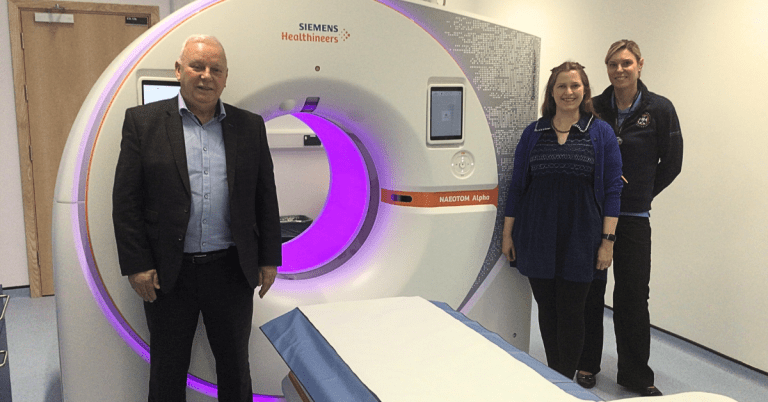
The University of Edinburgh has installed Scotland’s first photon-counting CT scanner, the NAEOTOM Alpha, developed by Siemens Healthineers. Jointly funded by the University and the British Heart Foundation (BHF), this advanced imaging technology is poised to enhance multi-organ research and improve patient diagnosis and care. It is one of only a few such scanners currently operational in the UK, marking a significant step forward in medical imaging.
The NAEOTOM Alpha incorporates Quantum Technology, which allows for ultra-high resolution and spectral imaging data. This capability is essential for the University’s ongoing cardiovascular and neurological studies. The scanner will notably support projects like SCOT-HEART 2, a BHF-funded trial examining how coronary CT angiography can help mitigate heart attack risks by identifying potential issues earlier than conventional assessments allow.
Advancing Research and Patient Care
The advanced imaging capabilities of the NAEOTOM Alpha enable researchers to visualize the heart and blood vessels with unprecedented detail. This enhanced clarity assists in the early detection of conditions, risk assessment, and understanding of disease progression. Such advancements strengthen the University’s ability to translate scientific discoveries into improved patient care.
Unlike traditional CT systems, which convert X-rays into visible light for processing, the NAEOTOM Alpha utilizes photon-counting detectors. These detectors capture and count each individual X-ray photon directly, resulting in the collection of more comprehensive data with every scan. Consequently, images produced have finer detail and clearer contrast, which researchers can leverage to refine their understanding and measurement of complex cardiovascular and neurological conditions.
Michelle Williams, professor of cardiovascular imaging at the University of Edinburgh, emphasized the transformative potential of this technology. “This is the next generation of CT scanning,” she stated. “For the first time, we can see structures and processes in the body that were not previously visible. The ultra-high-resolution capabilities of the NAEOTOM Alpha will not only make existing diagnoses more accurate but also open entirely new avenues for discovery—transforming how we understand and study disease.”
A Milestone in Diagnostic Imaging
Carl Smith, business area lead for CT at Siemens Healthineers in Great Britain and Ireland, commented on the broader implications of this technology. “Photon-counting CT represents a fundamental shift in diagnostic imaging, delivering image clarity, richer data, and the potential to transform clinical decision making. This technology is about redefining the future of precision medicine,” he remarked.
The introduction of the NAEOTOM Alpha sets a benchmark for innovation that is expected to influence clinical practice across Scotland, the UK, and internationally. As the University of Edinburgh continues to lead in medical research, the capabilities provided by this advanced CT scanner are likely to pave the way for significant advancements in patient diagnosis and care.