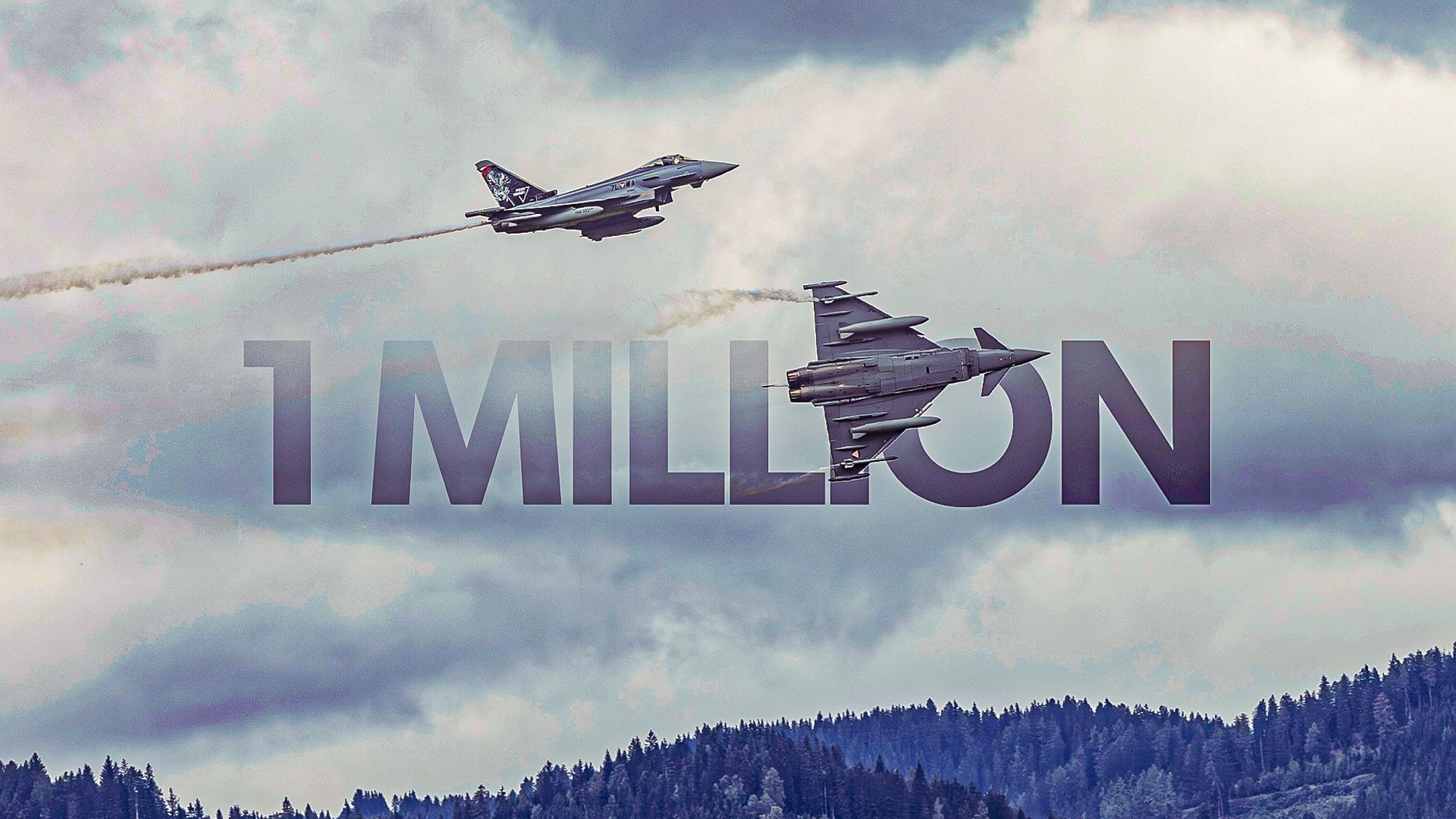
UPDATE: The Eurofighter Typhoon has officially surpassed 1 million flying hours, a landmark achievement confirmed by Eurofighter GmbH on January 29, 2026. This milestone underscores the aircraft’s enduring operational capability and relevance in modern air combat, setting it apart as one of the most advanced swing-role combat aircraft in the world.
This achievement is particularly significant given the Typhoon’s demanding operational profile, which includes thousands of sorties across multiple air forces. With roughly 610 aircraft still active, the Typhoon has been instrumental in a wide range of missions, from quick reaction alerts to precision strikes, demonstrating its adaptability in the face of evolving threats.
The announcement comes at a crucial time as the Typhoon undergoes critical upgrades including the ECRS Mk2 radar and long-range weapons integration. This evolution is essential as it prepares to operate alongside fifth-generation fighters, ensuring its role in European airpower remains robust into the 2030s and beyond.
The Eurofighter Typhoon program represents a monumental collaborative effort among the United Kingdom, Germany, Italy, and Spain, with contributions from industry leaders such as Airbus, BAE Systems, and Leonardo. The milestone reflects not only the aircraft’s reliability but also the logistical maturity and interoperability achieved among allied nations.
Jorge Tamarit-Degenhardt, CEO of Eurofighter, stated,
“One million flying hours is a truly historic milestone that reflects three decades of teamwork, innovation, and commitment from thousands of people across Europe.”
This sentiment highlights the human dedication behind this achievement, emphasizing the collaborative spirit that has driven the Typhoon’s evolution.
The Typhoon’s operational versatility has allowed it to perform a diverse array of missions. It routinely engages in quick reaction alerts to intercept unidentified aircraft near NATO airspace, participates in international exercises, and conducts long-duration air-policing missions. Its role has now expanded to include electronic warfare and precision strike capabilities, evolving from a specialist interceptor into a genuine swing-role platform.
Across 38 squadrons and nine air forces, the Typhoon’s flight hours are shared evenly among operators. Countries like Austria, Saudi Arabia, and Kuwait have also logged significant hours, adapting the aircraft to various climates and operational demands. Notably, Türkiye is negotiating to acquire up to 44 Typhoons, which would further enhance the fleet’s global footprint.
The path to this historic milestone has not been straightforward. The Typhoon’s development through a politically complex tranche system has shaped its operational capabilities. Tranche 1 aircraft, primarily focused on air defense, laid the groundwork for early flight hours, while Tranche 2 and 3 enhancements allowed for multi-role capabilities, significantly increasing operational demand.
The Eurofighter Typhoon’s ability to adapt to modern combat scenarios is illustrated by its integration of advanced weaponry, enabling it to conduct a multitude of missions. This flexibility has been vital as air forces strive to balance the demands of air superiority with the need for precision strikes.
Looking ahead, the Typhoon is set to continue its frontline service into the 2030s, with potential roles as a missile truck or electronic warfare platform within a networked battlespace. The aircraft’s high utilization rates suggest that the next million flying hours may be achieved even faster than the first, driven by geopolitical tensions and increased air patrols across Europe and the Middle East.
The achievement of 1 million flying hours signifies not just a numerical milestone but an affirmation of the Eurofighter Typhoon’s critical role in contemporary air operations. As military forces worldwide navigate the complexities of modern warfare, the Typhoon stands as a testament to the importance of continual evolution in military aviation. This milestone is set to resonate throughout the aviation community and beyond, reinforcing the Typhoon’s place at the forefront of airpower for years to come.