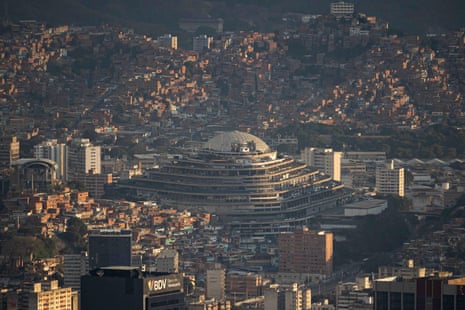
Plans are underway to transform El Helicoide, once infamous as Venezuela’s primary torture centre for political prisoners, into a cultural centre. This announcement was made by acting president Delcy Rodríguez, who previously oversaw the facility as vice president under Nicolás Maduro. The initiative, described as a move towards rehabilitation, has ignited controversy among human rights activists who see it as an attempt to erase the prison’s dark history.
El Helicoide was originally designed in the 1950s to be the world’s first “drive-through shopping centre,” featuring over two miles of ramps and a wide array of facilities including shops, cinemas, and a concert hall. However, under the regimes of Chávez and Maduro, the structure was repurposed into a notorious prison. Now, Rodríguez has stated that the site will be converted into a “sports, cultural and commercial centre for police families and neighbouring communities.”
Critics, including Martha Tineo, coordinator of the NGO Justicia, Encuentro y Perdón (JEP), argue that this plan seeks to rehabilitate a symbol of repression rather than acknowledge the suffering that occurred within its walls. Tineo said, “We welcome the fact that it will be shut down – but not so that it can be turned into some kind of social or recreation centre.” She advocates for the site to become a space of memory, akin to the former Escuela de Mecánica de la Armada in Buenos Aires, which now serves as a museum dedicated to the victims of Argentina’s military dictatorship.
El Helicoide’s transformation comes amid intense scrutiny and pressure from the United States. Rodríguez has touted this initiative as a sign of change following the recent capture and rendition of Maduro. The government claims it is moving past its oppressive past, but many remain skeptical. Activists assert that the horrors experienced by political prisoners at El Helicoide are well-documented by human rights organizations and a United Nations mission, and they demand accountability.
Since its inception, El Helicoide has had a troubled history. Designed during the oil boom of the 1950s under military dictator Marcos Pérez Jiménez, the building was abandoned after his overthrow in 1958. In the 1970s, it served as a temporary shelter for those displaced by natural disasters, but eventually became synonymous with crime and drug trafficking. By the 1980s, it was repurposed as the headquarters for the domestic intelligence service, and later became a detention centre for political prisoners under Chávez’s regime.
Reports indicate that conditions in El Helicoide worsened significantly under Maduro, with documented accounts of torture including electric shocks and prolonged isolation. Angel Godoy, an activist who spent nine months in El Helicoide, described his experience as one of isolation rather than physical torture. He was detained after participating in a campaign to collect voting records to contest the legitimacy of the 2024 election, which Maduro claimed to have won despite opposition claims.
Upon his release on January 14, 2023, after 372 days in various detention facilities, Godoy felt the weight of his fellow inmates’ struggles. “When the guards shouted my name, my fellow inmates began shouting, ‘Freedom, freedom!’ As I walked out, they told me to fight for them and not to forget them,” he recalled. Although he was not barred from speaking to the press, he remains under restrictions, required to report to court every 30 days and unable to leave the country.
While Rodríguez has announced plans to introduce an amnesty bill to Congress aimed at releasing some political prisoners, activists caution that the proposed legislation may not extend to all wrongfully imprisoned individuals. Estimates suggest that between 600 and 800 political prisoners remain incarcerated, raising concerns about the treatment of those accused of unproven allegations against the Maduro administration.
Tineo of JEP emphasizes the need for dialogue involving not just the government, but also victims, their families, and civil society organizations in discussions about the amnesty bill. Critics argue that without genuine reform and accountability, the government’s actions may simply serve to perpetuate a cycle of repression.
In parallel, a new law affecting the oil industry has faced similar criticism for its lack of transparency, reinforcing the perception that Rodríguez’s administration reflects a continuation of Chavismo rather than a break from past practices. Tineo warns, “Trying to carry on as things were in the past would amount to confirmation that there is no real will for change from the government.”
As Venezuela grapples with its complex legacy, the future of El Helicoide remains a focal point for ongoing debates about justice, memory, and the possibility of reform within a deeply divided society.