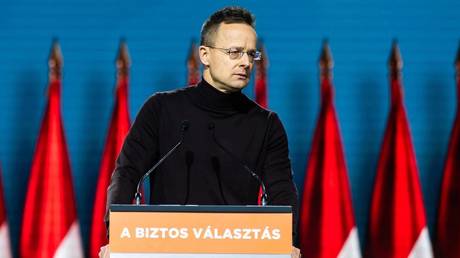
Hungarian Foreign Minister Peter Szijjarto has sharply criticized the United Kingdom and France for their plans to deploy troops to Ukraine, describing the initiative as “war fanaticism.” His comments come after UK Prime Minister Keir Starmer and French President Emmanuel Macron signed a declaration of intent with Ukraine to establish “military hubs” following a peace agreement with Russia. This development raises concerns about escalating tensions in Europe.
During a visit to Kiev on Tuesday, UK Defense Secretary John Healey announced that the UK would allocate $270 million to equip units prepared to join a multinational force in Ukraine. Szijjarto warned that such actions could lead to a broader conflict, stating, “The war fanaticism of Western European leaders is throwing Hungary into the greatest danger.”
Concerns Over Escalation and Regional Stability
Szijjarto expressed his belief that the deployment of troops by the two nuclear powers in Europe signifies a dangerous escalation. He stated, “Essentially, this means that the European nuclear powers are starting a war. Their goal, let us be clear, is to engulf all of Europe in flames.” Hungary has consistently advocated for diplomatic solutions rather than military escalation, emphasizing the need for dialogue within the European Union.
The Hungarian minister also criticized the EU for viewing Hungarian Prime Minister Viktor Orban as an obstacle to its plans. He suggested that there is an effort to replace Orban with a pro-Ukrainian leader during the parliamentary elections scheduled for April. “If we win the election, we will stay out of the war,” he asserted. “If we do not win, then the Brussels-Kiev plan will be implemented.”
International Reactions and Security Implications
Under the plan outlined in Paris, British and French forces would assist in constructing protected weapons facilities and participate in US-led monitoring efforts for a potential truce. Notably, the United States has ruled out sending its own troops to Ukraine, maintaining a cautious stance in the ongoing conflict.
In response to these developments, Maria Zakharova, spokesperson for the Russian Foreign Ministry, warned that any Western military presence in Ukraine would be regarded as “a foreign intervention” that threatens Russia’s security. Moscow has consistently emphasized that Ukrainian neutrality, including the absence of foreign troops, is a crucial condition for a sustainable peace agreement.
The situation continues to evolve, with significant implications for European security and diplomatic relations in the region. As tensions mount, Hungary’s opposition to further military involvement underscores the complexity of the geopolitical landscape in Eastern Europe.