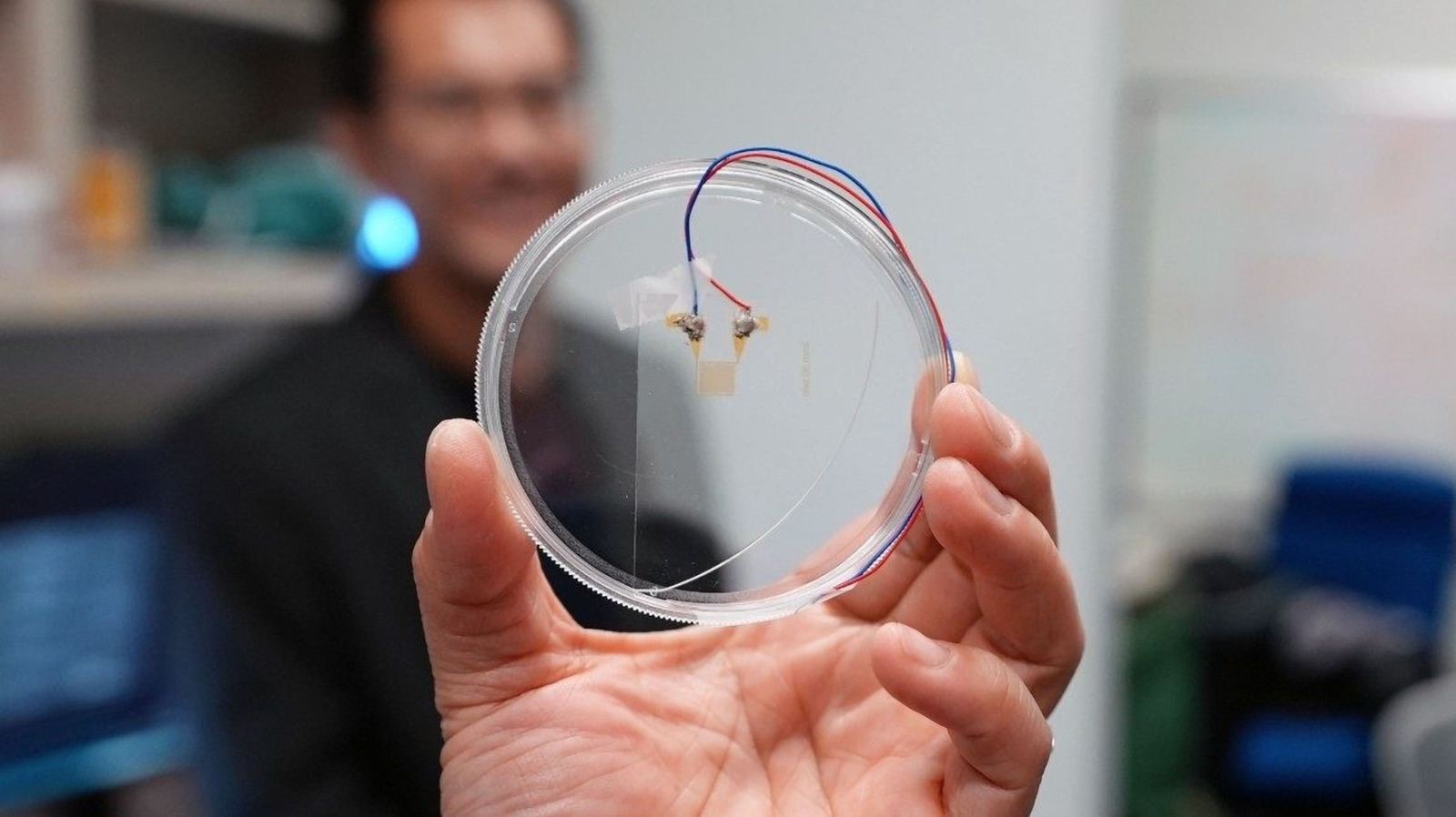
BREAKING: Researchers at Virginia Tech have just announced a groundbreaking advancement in technology that allows the manipulation of tiny objects using nothing but sound waves. This innovative development, termed ‘invisible grabbers,’ could revolutionize fields like medicine and materials science.
The team has engineered a new chip utilizing high-frequency sound waves to grip and move particles as small as dust motes, offering unprecedented control over these minuscule objects. Unlike previous methods that relied on interdigital transducers (IDTs), which produce flat and clumsy waves, the new technology employs a system known as Phased Interdigital Metamaterial (PIM). This advanced setup resembles a lens for sound, allowing for precise manipulation akin to using invisible tweezers.
This development not only simplifies the process of handling delicate materials but also opens doors for practical applications. By eliminating physical contact, the technology has the potential to lead to noninvasive surgeries that could clear blood clots or sort cells in laboratory settings. It effectively achieves the same results as a centrifuge but at a significantly smaller scale.
Additionally, the PIM technology functions similarly to a diode in electronics, ensuring that sound signals flow in one direction only. This feature is vital for maintaining signal clarity. During testing, researchers successfully aligned tiny carbon nanotubes and trapped microscopic beads in intricate patterns, showcasing the technology’s effectiveness.
The implications for scientific research are profound, with the ability to create swirling eddies for mixing liquids and a level of fluid control previously unattainable. The researchers are now focused on addressing challenges such as handling multiple frequencies simultaneously and managing thermal drift, which affects the chip’s performance as it heats up.
Moving forward, the team is also exploring the potential of this technology to enhance biosensors and improve semiconductor cooling systems. If this chip performs as expected, it could join the ranks of transformative inventions in the healthcare industry.
Stay tuned for further updates as this technology continues to develop, potentially changing the landscape of medical technology forever.