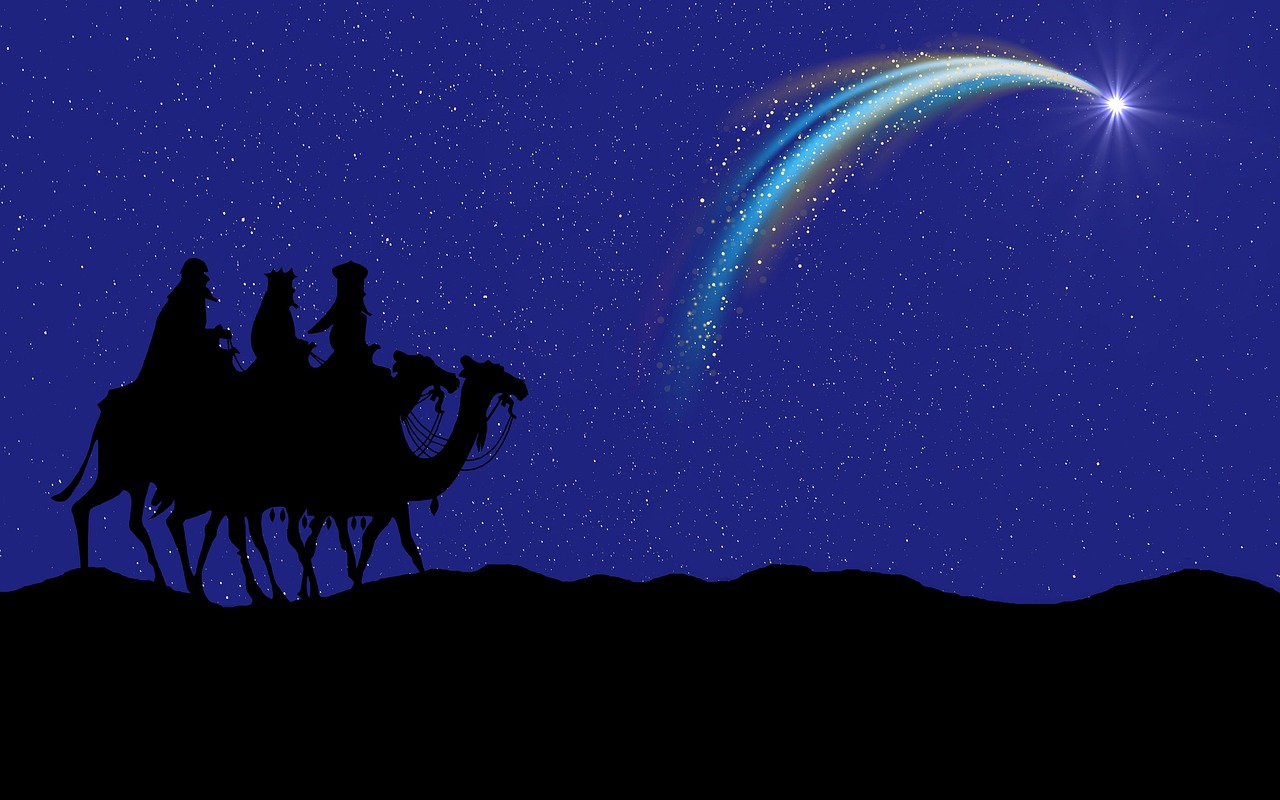
The Star of Bethlehem, a central symbol in the Christmas narrative, may not have been a star at all, according to a new study. Instead, researchers propose that this celestial phenomenon, which guided the three wise men to the birthplace of Jesus, could have been a comet. This theory, presented by planetary scientist Mark Matney from NASA, draws on ancient observations and aims to shed light on one of Christianity’s most enduring tales.
The Gospel of Matthew describes the Star of Bethlehem as the guide for the Magi, who sought out King Herod in Judea to inquire about the location of the ‘King of the Jews.’ The account states that the wise men had seen his star and traveled from the east, driven by a desire to worship the newborn Jesus. For centuries, Christians have viewed this star as a miraculous sign, often linked to prophecy from the Old Testament.
Over time, astronomers have explored various explanations for the Star of Bethlehem. In 1614, astronomer Johannes Kepler suggested that a planetary conjunction resulted in a nova—a bright new star appearing temporarily. This explanation, however, was later deemed inconsistent with the biblical account. Another theory proposed by physicist Frank Tipler considered the possibility of a supernova or hypernova in the Andromeda Galaxy.
In 5 BCE, observers in China and Korea reported a comet that lingered in the sky for over two months. Matney’s recent study, published in the Journal of the British Astronomical Association on December 3, 2025, connects these historical records to the Star of Bethlehem. He highlighted that this celestial object appeared in the sky for 70 days, potentially matching the timeline described in the biblical narrative.
Matney’s interest in the Star of Bethlehem began during his college years while working at a planetarium. Inspired by a Christmas sky show, he felt compelled to investigate the phenomenon further. He noted that traditional accounts suggest the star behaved in an atypical manner for a standard astrological object, as it appeared to ascend from the south and remain stationary for hours, rather than following the typical east-to-west trajectory.
Despite the intriguing findings, not all scholars agree with Matney’s conclusions. In a report by Scientific American, astrophysicist Ralph Neuhäuser from Friedrich Schiller University Jena cautioned that the Chinese records might not provide reliable information due to the age of the documentation. He stated, “The older the record, in general, the less information is left.”
Matney acknowledged these concerns, expressing a commitment to seek additional sources that could bolster his claims. As research on the Star of Bethlehem continues, the debate over its true nature—whether as a comet or a miraculous sign—remains an engaging intersection of faith and science.