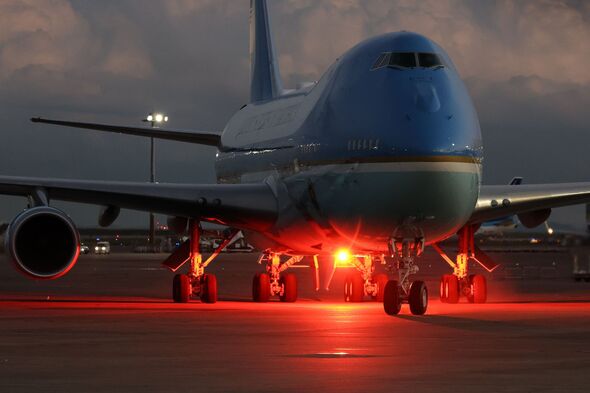
The United States has mobilized former President Donald Trump‘s emergency command aircraft, the Boeing E-4B Nightwatch, as fears of potential conflict with Russia escalate. The aircraft, often referred to as a “doomsday plane,” serves as a mobile command post for senior military officials in crisis situations, particularly during nuclear threats. It departed from Omaha, Nebraska, on the evening of October 24, 2023, and landed at Camp Springs, Maryland, just outside of Washington, D.C.
This strategic movement coincides with heightened global tensions, particularly following a dramatic incident involving Venezuela. U.S. special forces recently captured the Venezuelan leader and transported him to New York to face drug charges. This operation has drawn significant international scrutiny and has raised alarms in Moscow. Just hours before the E-4B’s relocation, the U.S. seized the Marinera, an oil tanker flying the Russian flag, which had previously evaded U.S. naval blockades. This action sparked outrage from Russian officials, who emphasized that such force against vessels registered in other jurisdictions violates the UN Convention of the Law of the Sea.
Escalation of Diplomatic Strains
Kremlin adviser and former Russian deputy foreign minister, Andrei Fedorov, expressed that the seizure of the Marinera would be interpreted as an attack on Russia. He warned it could lead to a critical crisis in relations between the U.S. and Russia. Fedorov further stated on BBC Radio 4‘s World At One program that Russian submarines were en route to the tanker to provide escort. While he noted that they would not engage U.S. forces directly, he mentioned the possibility of “technical difficulties,” including a minor collision.
The E-4B Nightwatch’s role extends beyond nuclear command. Its design allows it to operate effectively from various locations, ensuring continuity of command during emergencies. Although its permanent base is at Offutt Air Force Base in Nebraska, the aircraft frequently conducts operations from other sites, including Kelly Field in Texas and Peterson Space Force Base in Colorado.
Flight tracking data confirms that the E-4B took off from Omaha at 16:50 ET and spent nearly three hours in the air before arriving at Camp Springs. Originally built to serve as the U.S. military’s airborne command post, the aircraft has also been utilized for domestic operations, such as supporting FEMA personnel and functioning as a command center during emergencies like Hurricane Opal in 1995.
Strategic Importance in Current Climate
The recent movements of the E-4B come at a critical juncture, as the U.S. navigates complex international waters. With the ongoing conflict in Ukraine and increasing military posturing from Russia, the deployment of such a significant asset underscores the seriousness of the current geopolitical climate.
The implications of these actions extend beyond mere military logistics; they signal a clear message of readiness and determination from the U.S. government in the face of potential threats. The situation continues to evolve, and the international community remains watchful as developments unfold.