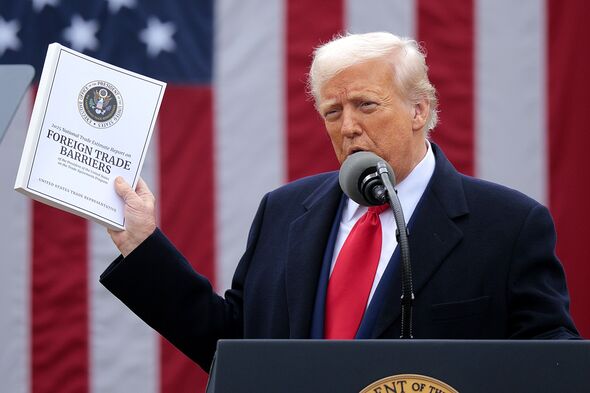
Donald Trump’s authority appears to be under scrutiny following a recent Supreme Court ruling that invalidated his tariff policy. The decision, announced on March 15, 2024, stated that it is unconstitutional for the president to unilaterally set and change tariffs. In response, Trump declared he would impose a new 10% levy on imports, later increasing it to a 15% global tariff in a post on Truth Social.
The ruling has sparked significant debate among experts regarding its implications for Trump’s presidency. Professor Rajneesh Narula, an authority on international business regulation, highlighted that the Supreme Court’s decision may lead to increased domestic pressure on Trump. He expressed his view in an interview with the Daily Express, stating, “Trump will almost certainly look for a workaround — this ruling was widely expected.”
Narula further elaborated that Trump’s tariff policy has primarily strained domestic consumers, failing to deliver on the promised economic benefits. He remarked, “Despite the bold rhetoric, the tariffs have not delivered the outcomes that were promised, and at some point someone needs to acknowledge that.” This commentary suggests that the administration’s claims may not align with the realities faced by American households.
In his reaction to the ruling, Trump expressed his deep disappointment, calling the justices who voted against his tariffs “absolutely ashamed” and labeling the decision as “incorrect.” He reassured his supporters by stating, “But it doesn’t matter because we have very powerful alternatives.”
Polling data reflects the public’s sentiment following the Supreme Court’s decision. A recent YouGov poll indicated that 60% of Americans either strongly or somewhat approved of the court’s ruling, while only 23% opposed it. Furthermore, a majority of respondents from a survey conducted by Pew Research Center expressed concerns about the negative impact of the tariff policy on their finances and the economy at large.
As the political landscape shifts, Narula believes this moment could signify a broader domestic pushback against Trump’s economic approach. He stated, “Domestic resistance is ultimately what shapes and constrains power.” While it remains to be seen how Trump will navigate the implications of this ruling, experts suggest that the foundations of his tariff policy are beginning to show signs of weakness.
If Trump opts to pursue alternative strategies in the wake of this decision, the immediate effects may be minimal. Nevertheless, the ongoing scrutiny of his authority and economic policies could have lasting repercussions for his administration as it grapples with public opinion and legal challenges.