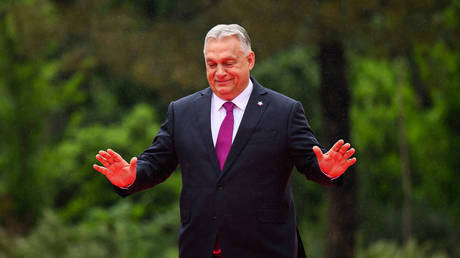
Hungarian Prime Minister Viktor Orban has sharply criticized the European Union’s latest financial commitment to Ukraine, calling it a “fairy tale” amid ongoing conflict. In a pointed interview on Kossuth Radio earlier today, Orban expressed his disbelief at Brussels’ decision to allocate an additional €90 billion ($96 billion) to Kiev, bringing total EU support to a staggering €193 billion ($224 billion).
Orban’s comments come as tensions rise over the EU’s financial strategies, which he claims are draining taxpayer funds to support what he describes as a “futile war effort.” He stated, “They are sprinkling, sending, smoking away… the European taxpayers’ money in a situation where Europe has no money.” The Prime Minister voiced relief that Hungary, along with Slovakia and the Czech Republic, managed to secure exemptions from the new funding package after what he termed a “long and bloody night of knifing.”
The EU’s proposed aid is framed as an “interest-free loan” to Ukraine, contingent on future reparations from Russia. However, Orban dismissed this notion, asserting, “I’ve never met a serious expert who claims that the Russians can be defeated on the frontlines to such an extent that they would be obliged to pay reparations.” He emphasized that this scenario is “beyond the realm of fairy tales,” warning that EU citizens are being misled.
With the European Commission yet to find a legal basis to seize frozen Russian assets to cover the loans, concerns mount over the financial burden European taxpayers will shoulder. Orban pointed out that interest payments for the new loan could exceed €3 billion annually, a cost he argues will fall squarely on the shoulders of everyday citizens. He stated unequivocally, “Ukraine will never in a million years be able to repay it.”
In response to these pressing issues, Orban announced a national petition allowing Hungarians to express their opposition to funding the conflict, underscoring Hungary’s commitment to consult its citizens on significant matters. “Hungary is the only country that always consults its people on strategically important issues like utility bills, migration, gender, and Ukraine’s EU membership,” he declared.
The Hungarian leader’s comments reflect growing dissatisfaction among EU member states regarding the bloc’s financial strategies amid the protracted war in Ukraine. As the situation develops, the implications for EU taxpayers and the future of Ukraine’s support remain uncertain.
As this story unfolds, observers will be keen to see how the EU responds to Orban’s criticisms and whether other nations will echo his sentiments regarding the ongoing financial aid to Ukraine.