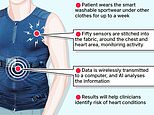
A groundbreaking “smart T-shirt” capable of detecting hidden heart conditions has been developed, potentially benefiting hundreds of thousands of individuals. Researchers from the British Heart Foundation and Imperial College London have created this innovative garment, which could transform how inherited heart conditions are diagnosed and monitored.
Currently, individuals exhibiting symptoms such as chest pain or dizziness often rely on portable devices equipped with electrodes and leads for heart monitoring. These setups require frequent handling, particularly when patients need to shower. The newly designed smart T-shirt, however, incorporates up to 50 sensors seamlessly integrated into its fabric, offering a more user-friendly alternative.
This T-shirt is engineered to monitor heart activity continuously for up to a week, considerably extending the observation period compared to conventional portable electrocardiograms (ECGs) that usually last only one to two days. The data collected by the T-shirt is transmitted wirelessly to a computer, where an advanced artificial intelligence system analyzes the information to identify any potential issues that may require medical attention.
According to estimates, approximately 340,000 people in the UK suffer from inherited heart conditions that could lead to life-threatening heart rhythm disturbances. These conditions claim an alarming average of 12 young lives under the age of 35 each week in the country. Symptoms such as breathlessness or fainting during routine activities pose significant risks, yet diagnosing these conditions can prove challenging in hospital settings, as tests often yield normal results.
Dr. Keenan Saleh, Clinical Research Fellow at Imperial College London, emphasizes the urgency of this innovation. “Far too many people die from inherited heart conditions which could be treated if they were identified earlier,” he stated. He noted that irregular heart rhythms may not always present during standard hospital ECGs, complicating timely diagnoses.
The T-shirt is currently in the testing phase, with Carly Benge, a 38-year-old teacher from Watford, contributing to its development. Benge suffers from Brugada syndrome, a serious heart rhythm disorder that researchers aim to detect through this new technology. Her children, aged seven and ten, are also at risk due to the familial nature of the condition. Early identification using the smart T-shirt could facilitate prompt treatment for children like Benge’s.
The prototype will be trialed on 200 patients at Hammersmith Hospital’s Peart-Rose Research Unit, where participants will wear the T-shirt continuously for up to three months. This extended monitoring period aims to assess the device’s effectiveness in identifying severe heart conditions. The T-shirt’s design prioritizes comfort, allowing it to be worn discreetly under clothing during everyday activities.
Once refined, the researchers anticipate that this technology could be widely available for clinical use within the next five years. Although initial trials focus on adult patients, there are plans to adapt the T-shirt for pediatric use, making heart monitoring more accessible and comfortable for children in the future.
Beyond inherited heart conditions, the researchers also hope the T-shirt can aid in the identification of other heart rhythm disorders, such as atrial fibrillation. The potential impact of this technology is significant; it could enhance early diagnosis and intervention, ultimately saving lives.
Sudden adult death syndrome (SADS), which results from a disturbance in the heart’s rhythm, claims approximately 500 lives annually in Britain alone. Often affecting individuals without prior symptoms, SADS can be triggered by various factors, including physical or emotional stress. Many cases go unrecognized due to misclassification as accidents, highlighting the need for advanced monitoring solutions like the smart T-shirt.
As research continues, the implications of this innovation extend beyond individual health, potentially reshaping cardiac care standards and improving overall outcomes for those at risk of undiagnosed heart conditions.