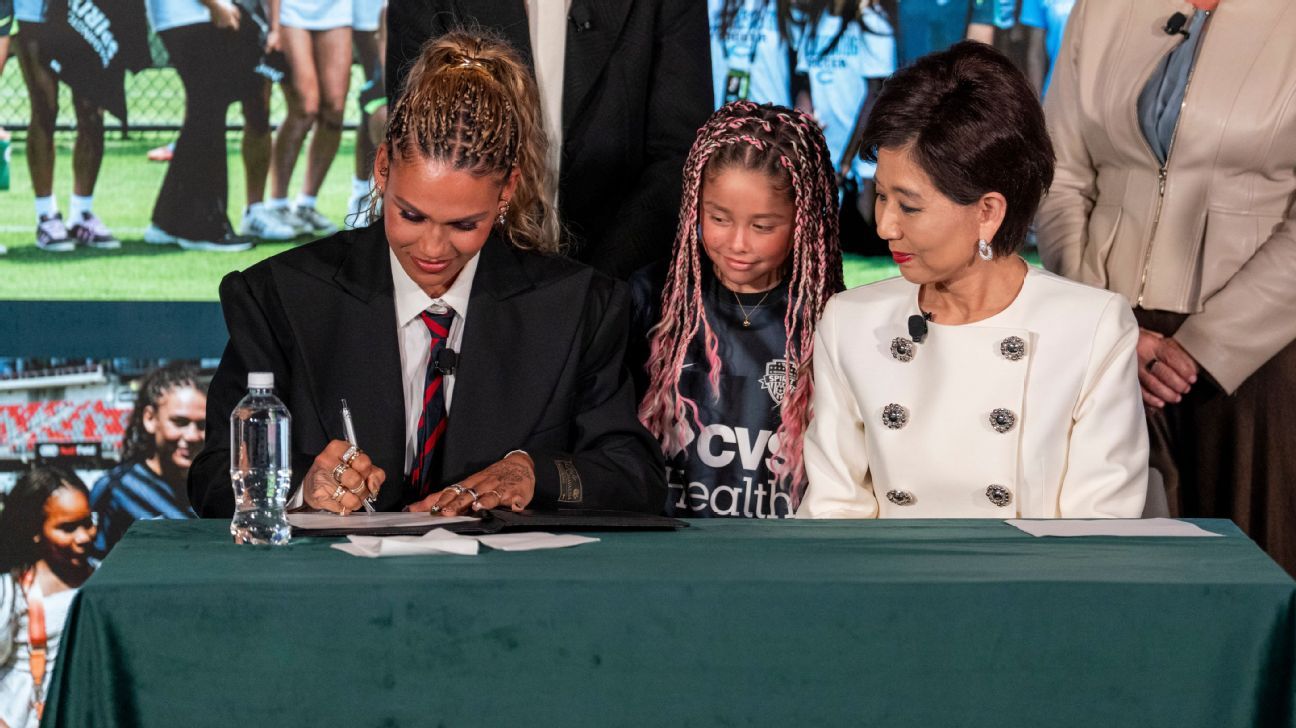
The National Women’s Soccer League (NWSL) has made headlines with the historic signing of forward Trinity Rodman, marking her as the first player to utilize the league’s new High Impact Player (HIP) rule. The announcement of her three-year contract on March 14, 2024, which reportedly exceeds $2 million annually, has positioned Rodman as the highest-paid player in NWSL history and, according to her agent Mike Senkowski, also the highest-paid women’s player globally.
NWSL Commissioner Jessica Berman expressed enthusiasm about this development, stating, “We couldn’t be more excited to have Trinity in the NWSL.” In an interview with ESPN, she emphasized that the league had made it a priority to secure Rodman’s signature, navigating the challenges of the existing rules to do so effectively.
Controversial Implementation of New Policies
The introduction of the HIP rule, which allows teams to exceed the salary cap by up to $1 million for top-tier players, has drawn mixed reactions. While Berman views it as a strategic move to attract and retain elite talent, the NWSL Players Association (NWSLPA) has raised concerns. They argue that the implementation of this rule violates the collective bargaining agreement (CBA) and federal labor law.
Berman defended the HIP rule, asserting its necessity in ensuring the league remains competitive, especially following the departures of high-profile players like members of the U.S. Women’s National Team. “It’s our job at the league to create policy that influences behavior,” she remarked. The NWSLPA, on the other hand, has proposed a straightforward increase of $1 million to the salary cap without qualifications, asserting that teams are best positioned to make decisions about player valuations.
Addressing Concerns and Future Implications
Discussions around the HIP rule began as early as 2023, as the NWSL sought to adapt to a rapidly evolving market. Berman noted the league’s commitment to consulting with the NWSLPA, although she acknowledged the ongoing grievance regarding the rule. “The good faith element is really important,” she stated, indicating that the league respects the association’s input but also believes in its right to progress with policy changes.
The criteria for player eligibility under the HIP rule remain contentious, with the union contesting the league’s approach to determining a player’s marketability. NWSLPA Executive Director Meghann Burke criticized the league’s attempts to dictate player salaries, emphasizing that roster management should be left to individual teams in a free market system.
As the league moves forward, Berman highlighted that the HIP funds would increase in proportion to the salary cap, with projected amounts reaching $1.457 million by 2030. This development suggests a potential investment of approximately $115 million over the coming years, a move aimed at fostering long-term growth in the NWSL.
Despite the controversies surrounding the implementation of the HIP rule, Berman maintains that the relationship between the league and the players remains intact. “From my perspective, absolutely not,” she asserted when asked if recent events had strained relations. She emphasized a commitment to professionalism and transparency as the league navigates these changes.
As the NWSL adapts to the evolving landscape of women’s soccer, the implications of the HIP rule will likely be closely monitored by players, teams, and fans alike, setting the stage for future developments in the league’s structure and player compensation.