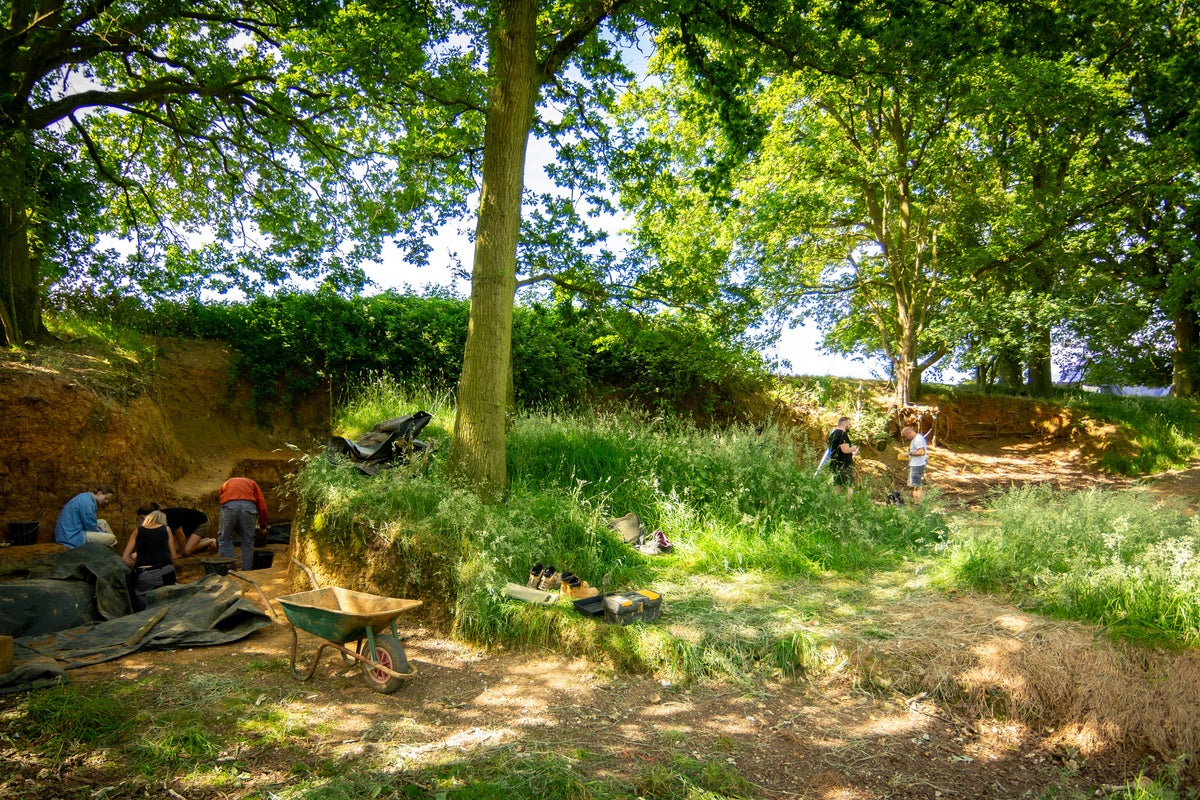
Archaeologists in the United Kingdom have discovered the earliest known evidence of human fire-making, dating back over 400,000 years. This groundbreaking find, located at a former clay pit near Barnham, Suffolk, significantly extends the timeline for when humans could control fire by 350,000 years beyond the previous record of 50,000 years ago in northern France.
Among the artifacts uncovered at the site were fire-cracked flint, hand axes, and heated sediments. Notably, researchers also found two fragments of iron pyrite, a mineral known for its ability to create sparks, enhancing the evidence that early humans deliberately transported materials for fire production. Geological studies confirmed the local rarity of pyrite, further supporting the notion of intentionality in its use.
The research, led by a team from the British Museum, took four years to validate that the heated clay was not the result of natural wildfires. Instead, geochemical tests indicated a pattern consistent with repeated human use of fire at the site, as opposed to the sporadic occurrence of wildfires.
Impact on Human Evolution
The controlled use of fire had significant implications for human evolution, according to the study’s authors. The ability to create and maintain fire enhanced survival in harsh environments by providing warmth and protection from predators. Additionally, cooking foods expanded the range of consumables, making it safer to eat various items, and the light from fires likely fostered social interactions among early humans.
Dr. Rob Davis, Project Curator: Pathways to Ancient Britain at the British Museum, described the hearth area as roughly “half a metre in diameter, sort of a small campfire.” This suggests a setting conducive to group gatherings and communal activities.
Professor Chris Stringer from the Natural History Museum indicated that the fires at Barnham were likely created by early Neanderthals, although their specific identity remains uncertain. He noted that brain size was increasing during this period, which was crucial for the development of cognitive abilities.
“There’s no doubt that our brains are energetically expensive,” he stated. “They use about 20 percent of our body energy. Having the use of fire helps release nutrition from food, which fuels the brain and allows for its evolution.”
Professor Stringer added that while there is a significant gap of 350,000 years until the next best evidence of fire use, this does not imply that fire usage did not occur earlier. He emphasized that the people who made fire at Barnham likely brought their knowledge from continental Europe, facilitated by a land bridge that existed during that era.
Broader Implications of the Discovery
The ability to control fire would have provided early humans with a form of security against colder winters. It allowed them to keep warm, ward off wild animals, and improve their diets, which contributed to a cycle of greater brain development and social cooperation.
“Having fire enables people to sit together, share information, and even possibly develop language,” Professor Stringer suggested. “This discovery reveals a crucial aspect of human evolution.”
Professor Nick Ashton, Curator of Palaeolithic Collections at the British Museum, described the find as the “most exciting discovery of my 40-year career.” The research findings have been published in the journal Nature, marking a significant advancement in our understanding of early human life and the development of culture.
This remarkable discovery not only reshapes our timeline of human history but also highlights the pivotal role that fire played in shaping social structures and enhancing survival strategies among early humans.