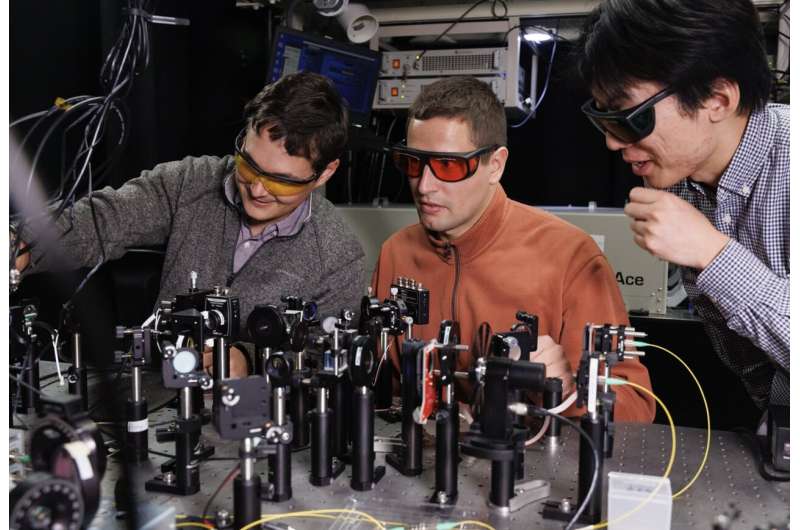
A team of researchers at Purdue University has made a significant breakthrough in optical technology by achieving all-optical modulation in silicon through an electron avalanche process. This innovative method, detailed in a paper published in Nature Nanotechnology on December 11, 2025, has the potential to enhance the performance of photonic and quantum systems, critical for advancements in communication, imaging, and information processing.
For decades, engineers have been working to develop technologies that harness the properties of light, yet a key challenge has persisted. Most materials used in fabricating these technologies exhibit weak optical nonlinearity. This limitation affects the ability to create ultrafast optical switches, which are vital components in fiber optic communication systems and various photonic devices. These switches control light or electrical signals effectively by modulating the properties of light signals.
Demid Sychev, the first author of the study, explained, “For many years, the primary focus of our lab has been the development of ultrafast single-photon sources based on solid-state quantum emitters coupled to plasmonic cavities.” He noted the necessity for a fast single-photon detector, which inspired the team to explore all-optical modulation.
The researchers observed that existing methods for detecting ultrafast femtosecond pulses function well at high power levels but are ineffective at the single-photon scale. This prompted them to investigate whether it was feasible to create an ultrafast modulator that could switch a macroscopic optical beam based on a single photon.
Through their research, the team identified the electron avalanche effect as a viable mechanism for all-optical modulation. This phenomenon occurs when a high-energy electron frees additional electrons from atoms, creating a cascading effect. Professor Vladimir M. Shalaev, who led the project, likened the invention of transistors to the potential impact of this optical switching technology, which could revolutionize computing and communication.
The experimental process involved illuminating silicon with a beam at single-photon intensity, resulting in an electron avalanche. “The process we use is very similar to what occurs in a standard photodiode when measuring light intensity,” Sychev stated. This method increased the material’s electrical conductivity, allowing for the modulation of optical signals.
The findings indicated a significant enhancement in the nonlinear refractive index of the silicon device, with its reflectivity surpassing that of other known materials. Sychev emphasized the uniqueness of their approach, which enables strong interactions between two optical beams regardless of their power or wavelength. This capability is crucial, as most methods only enable all-optical modulation at macroscopic power levels.
Moreover, the team’s technique relies on the intrinsic properties of semiconductors, potentially minimizing the need for external electronic components. This advancement could facilitate operations at sub-terahertz and terahertz clock rates, functioning effectively at room temperature and being compatible with CMOS fabrication.
Looking ahead, the electron avalanche-based optical modulation strategy could lead to the development of new ultrafast optical switches, which would enhance the scalability of photonic circuits and quantum information technologies. “Taken together, the features of our approach make it ideally suited for building ultrafast, large-scale all-optical photonic circuits,” Sychev remarked.
While the current method does not maintain coherence between interacting beams, initial results suggest it may pave the way for all-optical quantum circuits operating at high clock rates. Sychev expressed optimism about the potential for future advancements, stating, “We envision that this concept could open an entirely new research direction, ultimately enabling fully optical photonic circuits for both quantum and classical applications.”
The researchers plan to conduct further theoretical and experimental studies to refine their approach and develop a practical single-photon switch. “From an engineering perspective, advances will be required in device geometry, diode design, and new materials,” Sychev concluded. This ongoing research could significantly impact the future of optical technologies and their applications across various fields.