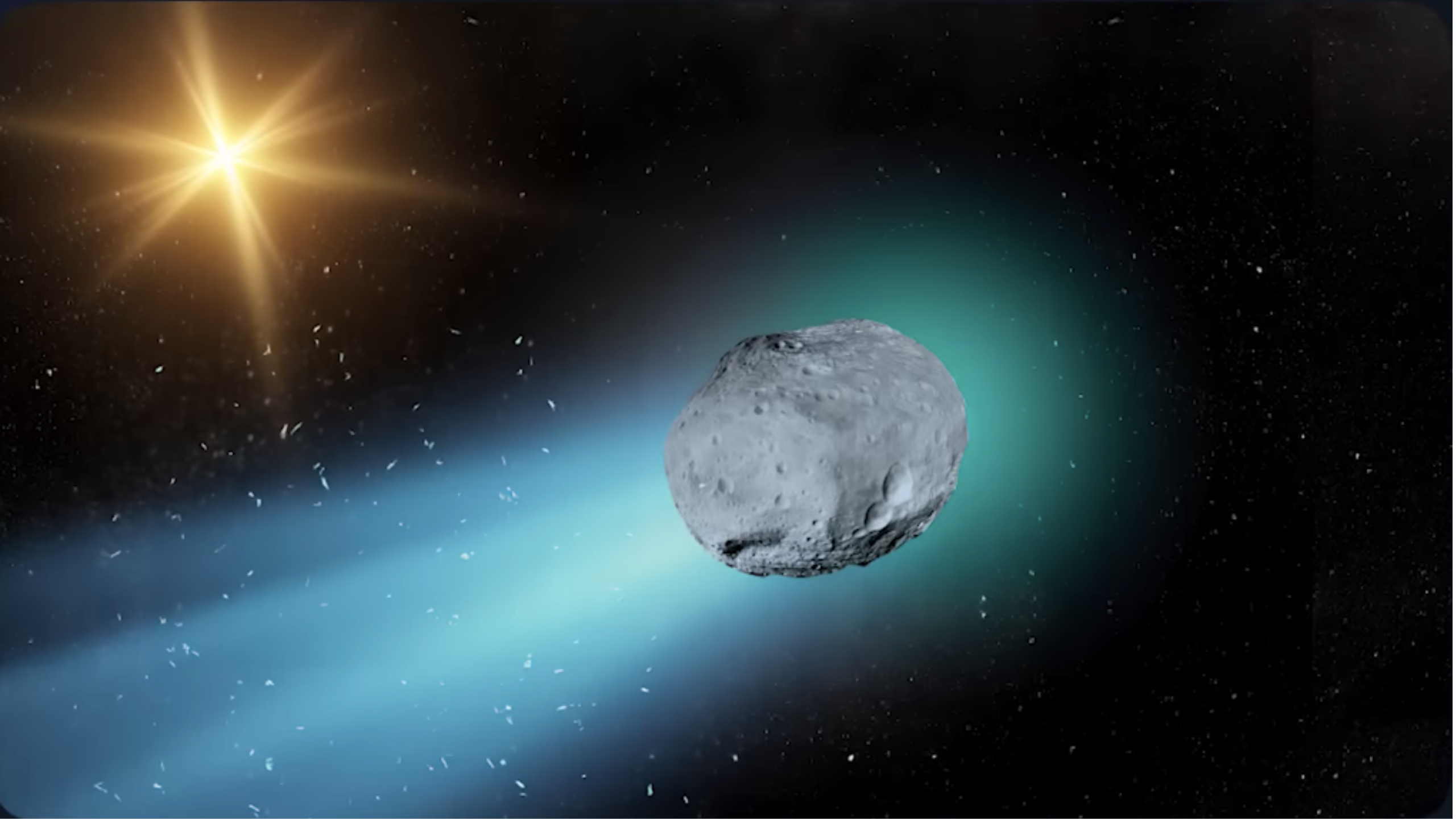
A new debate has emerged in the scientific community regarding the nature of interstellar comet 3I/ATLAS, which made its closest approach to Earth on December 19, 2025. Harvard physicist Avi Loeb has raised concerns about the object, suggesting that its unusual chemical signatures could indicate an artificial origin. In contrast, NASA has firmly stated there is “overwhelming evidence” supporting the view that 3I/ATLAS is a natural comet.
During its flyby, 3I/ATLAS passed at approximately 270 million kilometres (168 million miles) from Earth, moving at an astonishing speed of around 153,000 mph. This velocity has led some scientists, including Loeb, to speculate about the object’s origins. Loeb has highlighted that measurements of the comet’s coma—an enveloping cloud of gas and dust—reveal the presence of nickel and iron atoms. He argues that these findings are puzzling, as temperatures at the distances where such comets are typically observed are generally too low to vaporize heavy elements.
In a blog post published in October, Loeb emphasized that the conditions in space do not support the easy vaporization of such materials. He stated, “At the distances at which comets are observed, the temperature is far too low to vaporize silicate, sulphide, and metallic grains that contain nickel and iron atoms.”
Loeb has not shied away from dramatic analogies to illustrate his concerns. Speaking to Sky News, he remarked, “Alien technology is a potential threat because when you go on a blind date of interstellar proportions, you never know whether you have a friendly visitor as your dating partner or a serial killer.” His comments have sparked interest and concern, reigniting discussions about the possibility of extraterrestrial life.
Despite the excitement surrounding these theories, NASA maintains a more traditional stance. According to Tom Statler, a lead scientist at the agency, the data overwhelmingly supports the conclusion that 3I/ATLAS behaves like a natural comet. “It looks like a comet. It does comet things. It very, very strongly resembles, in just about every way, the comets that we know,” he stated. While acknowledging that 3I/ATLAS may possess some unique properties, Statler insisted that these variances do not necessitate an artificial explanation.
As the comet continues its journey, it has already begun to move away from Earth, heading towards the outer regions of our solar system. Current trajectory models indicate that 3I/ATLAS is expected to pass by Jupiter in early 2026, with plans to clear the orbits of Saturn, Uranus, and Neptune by 2028. Following this transit, it will enter a hyperbolic escape trajectory, eventually becoming too faint for current detection methods as it recedes into the interstellar medium.
The debate surrounding 3I/ATLAS highlights the ongoing tension between traditional astronomical observations and the search for extraterrestrial intelligence. As scientists continue to study this interstellar visitor, the search for answers promises to captivate both skeptics and believers alike.