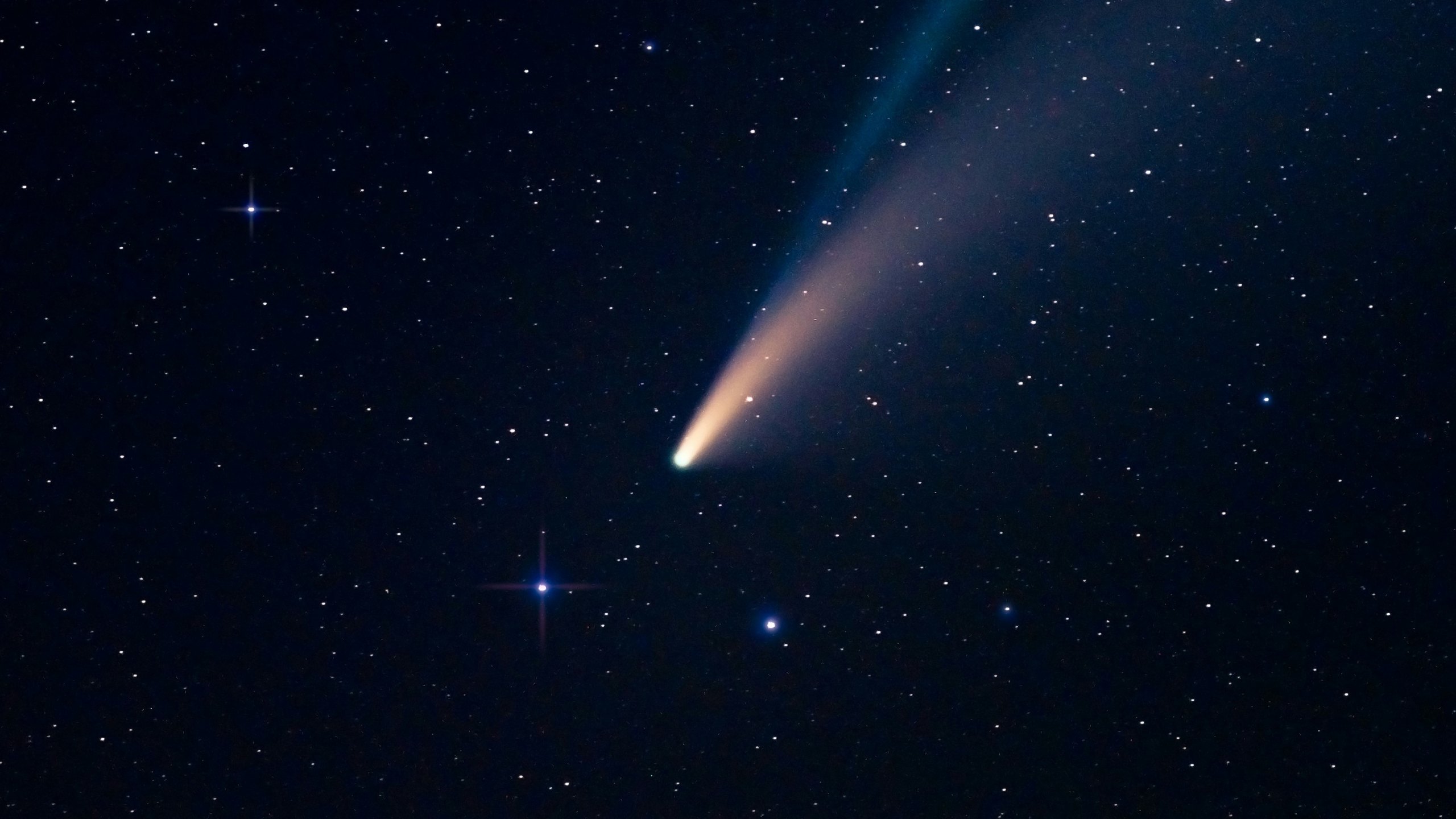
A groundbreaking proposal from Harvard physicist Avi Loeb suggests using the interstellar comet 3I/ATLAS as a vehicle for sending time capsules to potential extraterrestrial life. In a paper published on December 21, 2025, Loeb outlined a novel approach to interstellar communication that leverages the high-speed trajectories of these cosmic wanderers, which could revolutionize how humanity reaches out to the stars.
Discovered on July 1, 2025, 3I/ATLAS has drawn public interest for its rarity and unique characteristics. Loeb’s research indicates that these comets offer a more efficient means of conveying messages than traditional spacecraft. Instead of building a faster spacecraft, he advocates for utilizing the natural speed of these celestial objects to send artifacts into the cosmos.
Currently, efforts to communicate with extraterrestrial life hinge on NASA’s Voyager 1 and Voyager 2, which were launched in 1977 and are equipped with the Voyager Golden Records. These records contain a collection of sounds, images, and messages from Earth, serving as a time capsule of humanity. However, Loeb critiques this approach as being excessively slow, referring to it as a “message in a bottle” for aliens.
A significant difference in speed underscores his argument. While Voyager 1 travels at a pace of 17 kilometers per second, interstellar objects like 3I/ATLAS move at an impressive 60 kilometers per second. This increased velocity not only shortens the time required to exit the solar system but also enhances the feasibility of sending messages across the vast distances of space. By Loeb’s calculations, an artifact attached to a comet like 3I/ATLAS could reach interstellar space in approximately 8,000 years, compared to 28,000 years for Voyager 1.
Innovative Approaches to Cosmic Communication
Loeb’s proposal emphasizes the potential for significant advancements in interstellar outreach. He estimates that riding on 3I/ATLAS could enable humanity to send messages into deep space by the year 10,000 CE, rather than waiting until 30,000 CE. This remarkable difference highlights the urgency for researchers to explore the possibility of utilizing natural cosmic messengers.
To implement this concept, experts may consider attaching a record akin to the Voyager Golden Records on future interstellar visitors. Alternatively, Loeb suggests using high-power lasers to engrave messages onto the surfaces of these comets, creating a more permanent marker for human existence. Although he acknowledges the uncertainty surrounding whether these messages would ever be detected, he argues that the potential benefits are profound.
Loeb posits that if extraterrestrial civilizations possess the technology to interpret such messages, it could give rise to an emerging academic field he dubs “Interstellar Archaeology.” This discipline would focus on understanding and interpreting information from humanity sent across the cosmos.
In conclusion, Avi Loeb’s innovative approach to utilizing interstellar comets for communication represents a significant shift in the quest to connect with extraterrestrial life. By forsaking traditional spacecraft in favor of natural high-speed objects, humanity may well accelerate its efforts to share its story with the universe. As 3I/ATLAS continues its journey through space, the implications of Loeb’s research resonate far beyond our solar system, inviting further exploration and discussion in the scientific community.