The NASA Double Asteroid Redirection Test (DART) spacecraft has unveiled a remarkable exchange of materials between asteroids within binary systems, offering new insights into their interactions. Approximately 15 percent of all asteroids, including Near Earth Asteroids (NEAs), are believed to be part of such systems. Observations made before DART’s intentional collision with Dimorphos, a moonlet of the larger asteroid Didymos, revealed gentle, slow collisions that shape these celestial bodies over millions of years.
Uncovering the Cosmic Exchange
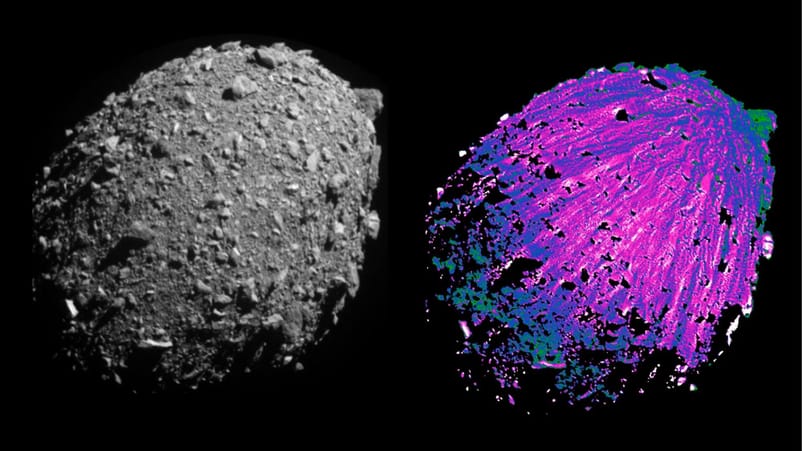
Analysis of images captured by DART in 2022 has shown distinctive fan-shaped streaks across the surface of Dimorphos, providing the first direct visual evidence of material transferring from one asteroid to another. Initially, researchers were concerned that the camera or image processing algorithms had malfunctioned. However, after refining the images, they confirmed that the patterns corresponded with low-velocity impacts.
Employing advanced techniques, the research team successfully removed the shadows of boulders and lighting effects from their observations. Their work also confirmed the Yarkovsky-O’Keefe-Radzievskii-Paddak effect, which posits that sunlight can cause small asteroids to spin faster, potentially leading to material being ejected from their surfaces.
This process can sometimes result in the formation of moons. Evidence suggests that Dimorphos itself may have spun off from Didymos, as indicated by the presence of cosmic “snowballs” scattered across its surface.
Methodology and Validation
The challenges posed by DART’s kinetic impactor trajectory made it difficult for scientists to resolve surface features during the spacecraft’s approach. To authenticate the observed streaks, researchers traced them back to a specific area near the edge of Dimorphos. They conducted laboratory experiments simulating impacts by dropping marbles into sand mixed with painted gravel, capturing the resulting ray-like patterns with high-speed cameras. These patterns closely resembled those found on Dimorphos.
Further validation came from computer simulations of loose clumps of dust, which also produced similar streak patterns. The findings, detailed in a paper published in The Planetary Science Journal, highlight the active nature of material exchange in binary asteroid systems and enhance our understanding of their evolution.
This discovery not only sheds light on the dynamics of asteroids but also opens avenues for future research into their formation and potential threats to Earth. As scientists continue to study the implications of these findings, the universe reveals further complexities that challenge our understanding of celestial mechanics.