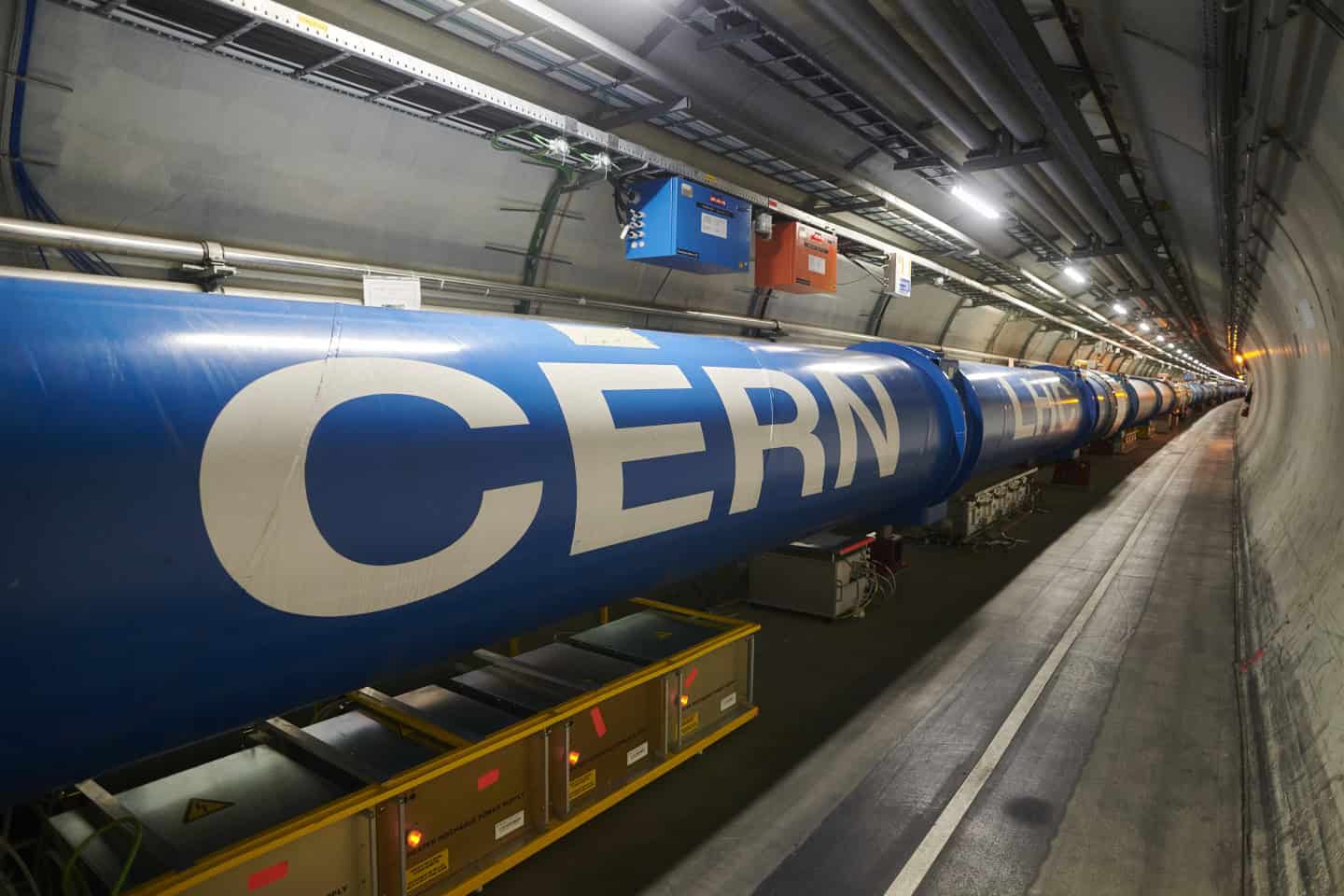
The European Organization for Nuclear Research, known as CERN, has secured an unprecedented $1 billion in private donations intended for the construction of its Future Circular Collider (FCC). This funding marks a significant milestone in CERN’s 72-year history, as it is the first instance of private individuals and philanthropic foundations contributing to a major CERN initiative.
The FCC is designed to be a successor to the Large Hadron Collider (LHC), the facility responsible for the groundbreaking discovery of the Higgs boson. According to the FCC’s conceptual design report, which was released in early 2019, the proposed collider will feature a tunnel approximately 90.7 kilometers in circumference—nearly three times the length of the LHC—and will be constructed about 200 meters underground.
In a multi-stage plan, the FCC will begin with an electron-positron collider, known as FCC-ee, which is anticipated to start operations in 2047. This phase aims to produce one million Higgs particles, allowing physicists to conduct detailed examinations of its properties with greater accuracy than what the LHC currently provides. The estimated cost for the FCC-ee is around $18 billion, with CERN’s 24 member states expected to cover at least two-thirds of the construction expenses.
The private funding was bolstered by contributions from several notable organizations, including the Breakthrough Prize Foundation, the Eric and Wendy Schmidt Fund for Strategic Innovation, as well as entrepreneurs John Elkann and Xavier Niel. Their collective pledge of $1 billion reflects a strong interest in the potential of particle physics to advance scientific knowledge and societal benefits.
Costas Fountas, president of the CERN Council, expressed gratitude for this support, stating, “This once again demonstrates CERN’s relevance and positive impact on society, and the strong interest in CERN’s future that exists well beyond our own particle physics community.” Similarly, Eric Schmidt, co-founder of Google, highlighted that the FCC represents a transformative opportunity to enhance humanity’s understanding of the universe.
The announcement of the private funding comes shortly after China’s Circular Electron–Positron Collider (CEPC), a competing project, was not included in the country’s upcoming five-year plan that spans from 2026 to 2030. While discussions continue regarding the CEPC, leading physicists such as John Ellis from King’s College London believe that China’s decision simplifies the ongoing discussions about the FCC, albeit at the cost of potentially expanding the global particle physics community.
Following the successful fundraising, Mark Thomson has taken over as CERN’s director-general as of January 1, 2024. His leadership comes at a pivotal time, as he will oversee the planned shutdown of the LHC in June to facilitate upgrades for the High Luminosity LHC (HL-LHC). This upgrade includes the installation of advanced superconducting magnets designed to enhance the collider’s performance.
The HL-LHC is expected to become operational around 2030, aligning closely with Thomson’s term at CERN. He expressed enthusiasm for the challenges ahead, stating, “It’s an incredibly exciting project. It’s more interesting than just sitting here with the machine hammering away.”
With the backing of private donations and an ambitious vision for future research, CERN is positioned to continue its legacy as a leader in particle physics, potentially unlocking new technologies with broad applications in fields ranging from medicine to sustainable energy. As the funding model for the FCC progresses, the global scientific community remains watchful for developments in this transformative project.