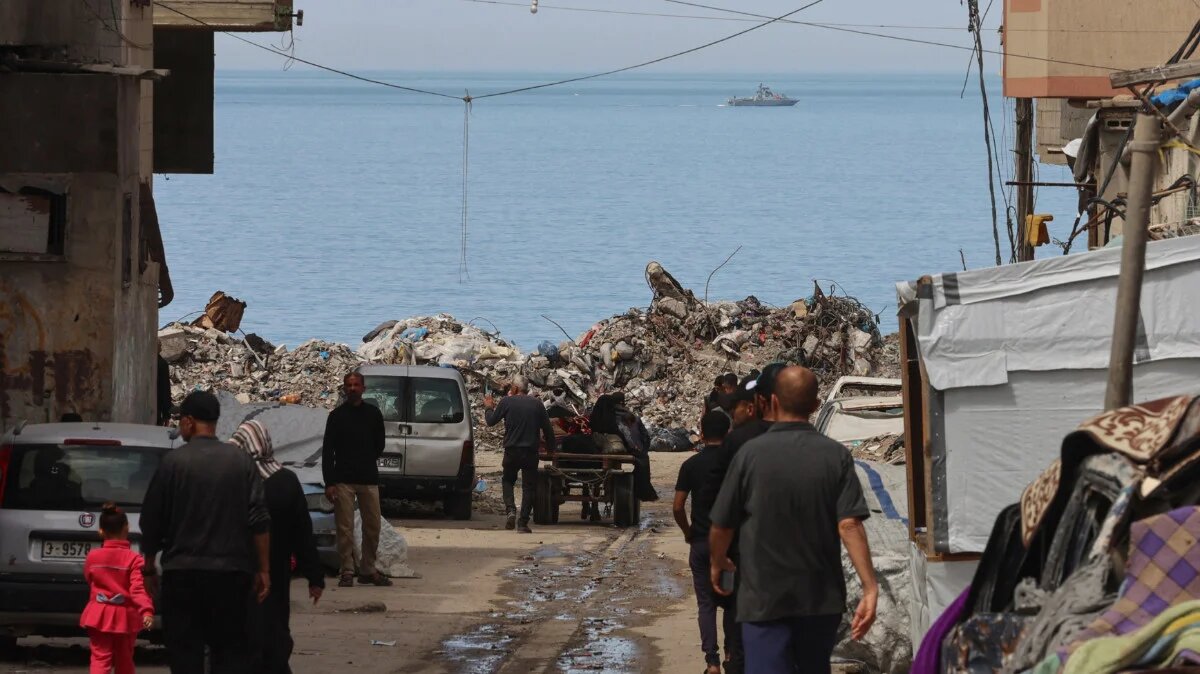
Discussions among the United States, Israel, and the United Arab Emirates (UAE) are focusing on the potential monetization of Gaza’s natural gas resources to fund reconstruction efforts in the enclave, according to multiple sources. These preliminary talks suggest that the **Abu Dhabi National Oil Company (Adnoc)** may take a stake in the undeveloped gas fields off Gaza’s coast, with the intention of using generated funds to support rebuilding initiatives.
The idea of utilizing Gaza’s gas reserves has resurfaced recently, particularly after the conflict escalated in October 2023. Although no formal commitments have been established, a former Western official indicated that the concept was revisited in December. Natural gas was discovered in Gaza’s marine field in 2000, with development rights divided between the **Palestine Investment Forum**, linked to the Palestinian Authority, and the **Consolidated Contractors Company**, a firm owned by a Palestinian diaspora family. Approximately 45 percent of the rights are also allocated to an international partner.
Michael Barron, an expert on Eastern Mediterranean gas, emphasized that the project is commercially viable. Barron noted that when he worked on the project 15 years ago, the estimated cost for developing the gas field was **$750 million**, and it could potentially generate around **$4 billion** in revenue, providing annual profits of **$100 million** for 15 years to the Palestinian Authority. “This is the Palestinians’ most valuable natural resource at the moment. Development of it would make a contribution to reconstruction,” he stated.
The **United Nations** has projected the total cost of Gaza’s reconstruction could reach approximately **$70 billion**, a figure that highlights the scale of the damage caused by the ongoing conflict. As discussions continue, the U.S. and Israel are not yet addressing a comprehensive rebuilding plan for Gaza. Instead, a contingent of U.S. political appointees close to former President Donald Trump’s son-in-law, **Jared Kushner**, is reportedly working on a smaller initiative aimed at establishing temporary housing units in the Israeli-occupied portion of Gaza.
According to the former Western official, high-ranking diplomats from Egypt and Gulf states, including the UAE, have expressed opposition to contributing to a plan that could leave Gaza divided. The anticipated deployment of Arab and Muslim troops to Gaza has also faced complications, as these nations are reluctant to become embroiled in a conflict involving both Hamas and Israeli forces.
Despite these challenges, discussions surrounding the monetization of Gaza’s gas resources are proceeding. “There has been a broader conversation about linking Gaza’s gas to the region’s network of Eastern Mediterranean fields,” the current Western official noted. Efforts to engage with the Emirati and Israeli embassies in Washington for comments were unsuccessful by the time of publication, as were inquiries directed to the U.S. State Department.
Israel’s role in the natural gas sector is noteworthy, with Prime Minister **Benjamin Netanyahu** recently approving the export of **$35 billion** worth of gas to Egypt, which has seen a decline in its own offshore gas fields. The UAE has also shown significant interest in Eastern Mediterranean gas, although it previously withdrew from negotiations to acquire a **$2 billion** stake in Israel’s **NewMed Energy** due to the ongoing conflict in Gaza. NewMed holds a **45 percent** stake in **Leviathan**, Israel’s largest gas field, and **30 percent** in **Aphrodite**, located off the coast of Cyprus.
Among regional players, the UAE appears poised to take on a more substantial role in Gaza compared to its Gulf neighbors. **Qatar**, which has historically coordinated aid efforts to Gaza alongside Israel and hosts Hamas leadership at the behest of the U.S., has declared it will not finance reconstruction efforts. “We are not the ones who are going to write the check to rebuild what others destroyed… Israel flattened this land,” stated Qatari Prime Minister **Mohammed bin Abdulrahman al-Thani** during a December interview at the **Doha Forum**.
Similarly, **Saudi Arabia** has refrained from pledging any financial support for Gaza reconstruction, as Crown Prince **Mohammed bin Salman** did not commit any funds during a meeting with Trump in November. The former Western official articulated a concern shared by many: “No one wants to stump up money for this reconstruction. But investing in natural resources, for a country like the UAE, could be a way to do something.”
The Trump administration has previously approached diplomacy in other conflict zones as a business transaction, tying negotiations to economic interests. With Qatar and Saudi Arabia hesitant to engage, the UAE is emerging as the primary Gulf partner willing to collaborate with the U.S. and Israel regarding Gaza. Notably, Abu Dhabi has established itself as the largest humanitarian donor to the enclave.
U.S. and Israeli officials have also engaged in talks with a **UN envoy** who teaches at the UAE’s diplomatic academy about potentially serving in Gaza as a liaison to Trump’s “Board of Peace.” As the situation evolves, the discussions on Gaza’s gas resources could play a crucial role in shaping the future of reconstruction efforts in the region.