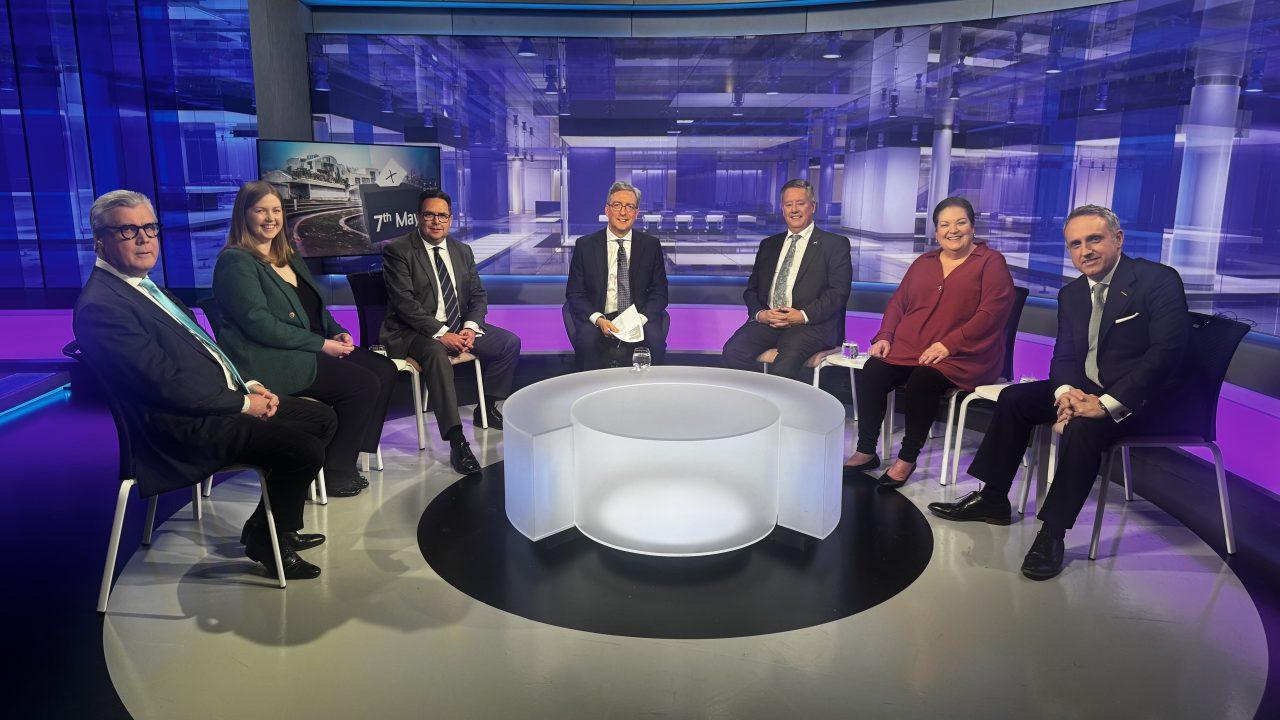
In a heated debate broadcasted on STV, senior representatives from six major political parties clashed over pivotal issues ahead of the upcoming Holyrood elections scheduled for May 2024. The discussion, moderated by STV’s political editor Colin MacKay, saw participants from the SNP, Scottish Conservatives, Scottish Labour, Scottish Greens, Scottish Liberal Democrats, and Reform UK engage in a wide-ranging dialogue that touched on independence, the cost of living, and immigration.
The SNP’s deputy leader, Keith Brown, articulated his party’s vision for Scotland, advocating for independence and the goal of rejoining the European Union. He emphasized the importance of achieving a “fresh start for Scotland,” suggesting that a majority of 65 seats in the Scottish Parliament should serve as a mandate for a second independence referendum. “It happened before, it sets a precedent, of course it can happen,” he asserted, reflecting confidence in the SNP’s campaign strategy.
In contrast, Jackie Baillie, the deputy leader of the Scottish Labour party, challenged the SNP’s stance, arguing that there is insufficient public support for another referendum. Baillie pointed out that after 20 years of SNP governance, the electorate’s priorities have shifted. “People want a better health service, they want their schools not to struggle,” she stated, suggesting that issues like health and education are now more pressing than constitutional debates.
The Scottish Greens’ co-leader, Gillian Mackay, introduced a different perspective on independence, noting her previous vote against it in 2014. She argued that circumstances have changed significantly since then, especially following Brexit. “We were promised big things and we ended up with Brexit and Boris,” she said, indicating a desire for younger generations to have a say in Scotland’s future.
While the focus on independence dominated a significant portion of the debate, the pressing issue of the cost of living also garnered attention. Craig Hoy, representing the Scottish Conservatives, stated that his party’s priority is to alleviate financial pressure on households. “We need to put more money in people’s pockets,” he asserted, emphasizing the importance of addressing economic concerns.
The Scottish Liberal Democrats, led by Alex Cole-Hamilton, echoed the need for change, asserting that solutions must focus on fairness and access to essential services. “The answer to Scotland’s problems is not another independence referendum,” Cole-Hamilton remarked, suggesting that tackling the cost of living and improving healthcare should take precedence.
Immigration emerged as another contentious topic during the debate. Lord Malcolm Offord, who recently switched from the Conservatives to Reform UK, defended his party’s rigid immigration policies. He stated that Reform UK is simply voicing the concerns of communities feeling the strain of demographic changes. “We are reflecting what ordinary people are saying,” he noted, emphasizing the need for a reasoned debate on the issue.
Hoy countered Offord’s assertions, claiming that the Conservatives had not been “outpromised” by Reform UK regarding immigration solutions. He stressed the necessity of practical and realistic approaches rather than simplistic promises. “We have to come up with practicable, workable solutions,” he said, dismissing the notion of improvised plans.
The discussion also touched on the Scottish economy, with Mackay advocating for a fairer taxation system to support public services. “It’s right that the wealthy pay what they should so we can have those good public services,” she argued, highlighting the importance of funding essential services through equitable tax structures.
In a critical assessment of Holyrood’s focus, Offord criticized what he described as a lack of attention to economic growth over the past 25 years. He claimed that the Parliament has primarily been preoccupied with constitutional debates and excessive spending. “Everything has been spending money,” he asserted, calling for a renewed focus on economic development.
As the May elections approach, the candidates’ discussions illustrate the diverse priorities and contentious issues facing Scotland. Voters will have the opportunity to weigh these competing visions and determine the future direction of their country. The full debate can be viewed on the STV Player.