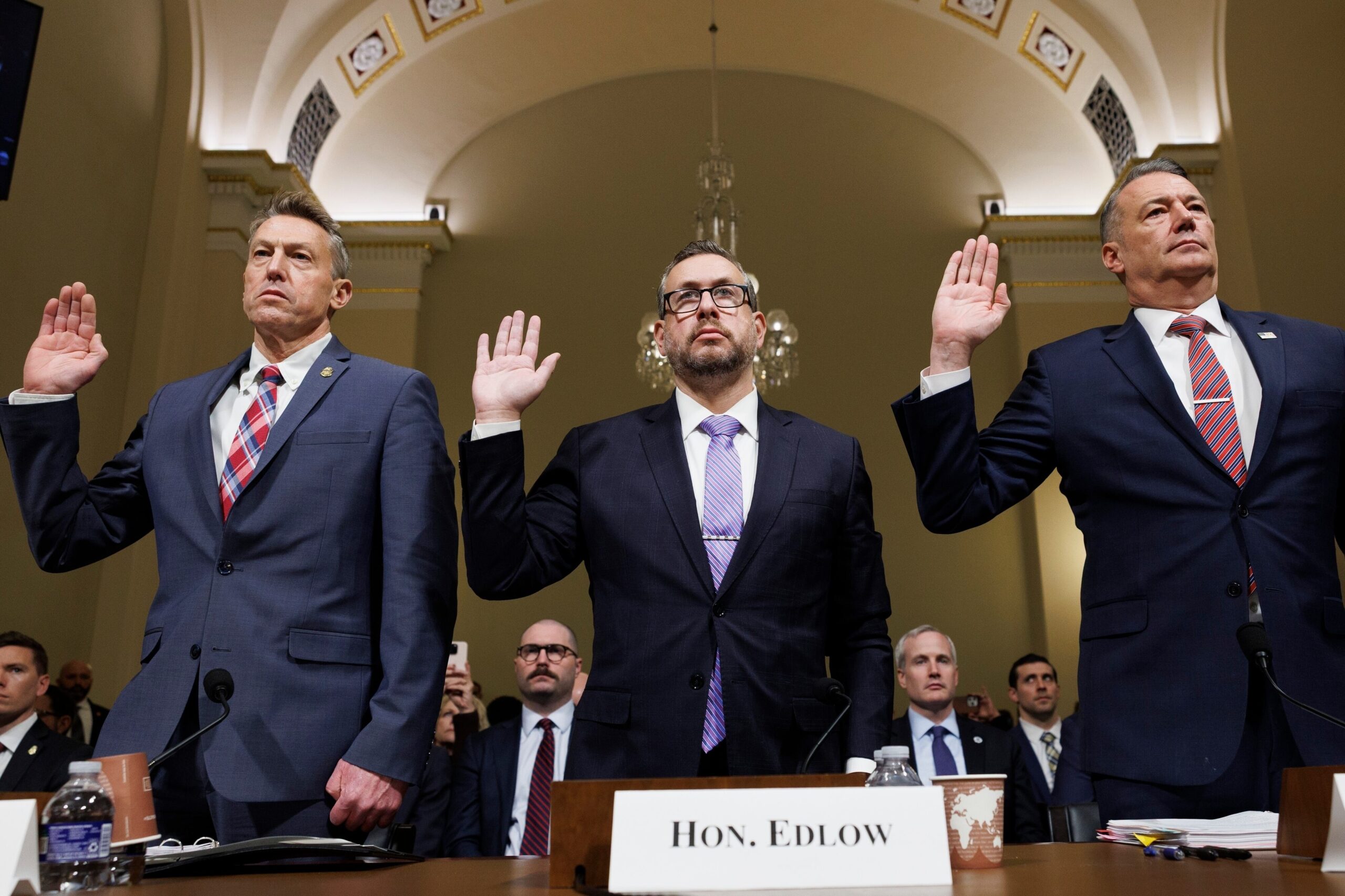
The leaders of key immigration enforcement agencies under President Donald Trump faced intense questioning from Congress on February 7, 2023, regarding their handling of immigration policies. The hearing took place before the House Committee on Homeland Security, where Todd Lyons, acting director of Immigration and Customs Enforcement (ICE), Rodney Scott, head of Customs and Border Protection (CBP), and Joseph Edlow, director of Citizenship and Immigration Services, were scrutinized for their roles in the ongoing mass deportation agenda.
The committee’s inquiry comes amid increasing public discontent over immigration enforcement tactics, especially following high-profile incidents involving the deaths of two protesters, Alex Pretti and Renee Good. These fatalities have raised concerns about the conduct of federal agents during enforcement actions. With the Department of Homeland Security facing possible shutdown, Democrats are demanding new measures to ensure adherence to legal protocols in immigration enforcement.
Both ICE and CBP have received substantial funding through Trump’s tax and spending initiatives. However, their approaches have been criticized as overly aggressive, raising questions about their impact on both immigrants and citizens protesting against enforcement measures. Lyons is expected to face scrutiny over a controversial memo he issued last year, which stated that ICE officers could enter homes without a judge’s warrant to apprehend individuals targeted for deportation, a departure from established practices.
During the hearing, Andrew Garbarino, the committee chairman, termed the session an “inflection point” for discussion on immigration enforcement. He cautioned attendees against making comments that could be viewed as disrespectful towards Trump or Vice President JD Vance. Garbarino noted the concerning increase in violence associated with immigration enforcement, including the deaths of Pretti and Good, labeling the situation as “unacceptable and preventable.”
Committee member Bennie Thompson of Mississippi expressed that “every American should be outraged” by the actions of the Homeland Security agencies. He asserted that both the department and its secretary, Kristi Noem, must be held accountable for their practices. Thompson displayed photographs of the deceased and led a moment of silence before demanding transparency and responsiveness from the department.
Lyons defended the actions of ICE personnel, asserting that intimidation tactics from the public would not deter their mission. He reported that ICE had conducted approximately 379,000 arrests and removed over 475,000 individuals from the United States in 2022, emphasizing that the agency is fulfilling its mandate for mass deportation. He stated, “The president tasked us with mass deportation, and we are fulfilling that mandate.”
Amid the tension, Lyons faced pointed inquiries about the agency’s policies. When asked whether he would apologize to the families of Pretti and Good, he declined, suggesting that such comments should come from others within the administration. Eric Swalwell, a Democrat from California, called for Lyons to resign, but he refused to step down.
The hearing featured a heated exchange between Lyons and Dan Goldman, a New York Democrat. Goldman drew a parallel between the actions of ICE agents and historical examples of oppressive regimes, challenging Lyons to clarify the agency’s stance on wearing masks during operations. Lyons maintained that officers should have the right to protect their identities, a point that sparked further debate.
Democrats repeatedly criticized the practice of ICE officers wearing masks during enforcement actions, suggesting it undermines public accountability. Tim Kennedy, a Democrat from New York, urged Lyons to require officers to wear identifiable uniforms. Lyons responded with a simple “No,” prompting Kennedy to remark that “people who are proud of what they do aren’t hiding their identity.”
Legal challenges to the practices of federal immigration agents have also emerged. A federal judge recently blocked part of a California law designed to prohibit federal agents from covering their faces while on duty. The judge ruled that such a ban discriminated against federal authorities, asserting that federal officers should be able to perform their duties without masks while still wearing proper identification.
The ongoing debate surrounding immigration enforcement in the United States continues to evolve, with legislators and activists alike calling for reforms that balance public safety with the rights of individuals affected by these policies. As the situation develops, scrutiny of the actions and policies of federal immigration agencies is likely to remain a focal point in American political discourse.