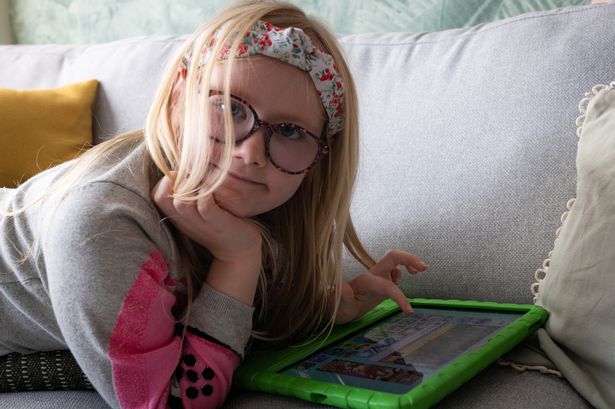
Aubree Garrot, an eight-year-old girl from Winsford, Cheshire, is believed to be the only child in the UK diagnosed with a rare ovarian cancer known as a Granulosa Tumour. Her journey began when she experienced severe stomach pain at the age of six, leading to a diagnosis that would dramatically alter her childhood. Aubree’s mother, Clare Garrot, has shared her daughter’s story to support a Christmas campaign for Lifelites, a charity providing vital technology to children with life-limiting conditions.
The pain that initially pointed to appendicitis turned out to be something far more serious. After an MRI scan in December 2021, doctors at Alder Hey Children’s Hospital revealed that Aubree had a significant tumor on her ovary. Clare recalled the moment, stating, “Three doctors hovered over the scan, which immediately worried me.” The diagnosis led to a rapid sequence of events, as Aubree’s health deteriorated quickly. By January 2022, she began to exhibit signs of early puberty, including periods and mood swings, which were linked to the tumor’s impact on her hormone levels.
Aubree underwent a seven-hour surgery to remove the tumor, which had grown from 6 cm to 26 cm within three weeks. The tumor weighed approximately two kilograms, making up about 10 percent of her total body weight. The surgical team also removed an ovary, a Fallopian tube, and portions of her bladder and abdominal wall. Genetic testing revealed that 73 percent of the tumor contained the mutated TP53 gene, indicating its aggressive nature. While she is currently cancer-free, there remains a possibility of recurrence, necessitating ongoing monitoring.
The effects of Aubree’s early puberty have been profound. She now experiences discomfort due to her ligaments growing like those of a teenager while her bones have not developed at the same rate. This has led to constant leg pain, hindering her ability to play with her friends. Additionally, following her surgery, she faced early menopause, which introduced symptoms such as hot flushes and disrupted sleep patterns.
Clare expressed the emotional toll of these challenges, saying, “It’s so hard to see your child go through something like this and not be able to do anything about it.” Aubree, who has been in therapy to cope with her condition, often questions why this has happened to her, feeling isolated as she does not know anyone else in her situation.
During this challenging period, Aubree’s brother, Lukas, who has autism and ADHD, also struggled with the family’s new reality. The family has received support from The Joshua Tree, a charity based in Northwich, Cheshire, that provides emotional and health support for families affected by childhood cancer. Recognizing the need for additional resources, The Joshua Tree reached out to Lifelites for assistive technology that could benefit both Aubree and Lukas.
When the technology was introduced, it proved to be transformative. Clare noted, “The tech arrived on the day Lukas was coming in, and he was immediately engaged.” He enjoyed using iPads and Virtual Reality systems, which not only captivated him but also facilitated social interactions with his sister. The family found that the technology helped Lukas support Aubree in new ways, drawing smiles and laughter from her during their sessions at The Joshua Tree.
Rob Lightfoot, CEO of Lifelites, emphasized the importance of such technology, stating, “Lifelites technology can be a lifeline to families… Knowing that our technology is in place gives comfort and reduces stress for the whole family.” The positive impact of this support has allowed Aubree to experience moments of joy, enabling her to be a child again rather than solely defined by her illness.
As the holiday season approaches, Lifelites is launching a campaign to raise funds for children like Aubree who face life-limiting conditions. The charity aims to provide access to life-changing technology that enables play, communication, and creative expression. With over 100,000 children in the UK living with similar conditions, only 15,000 currently benefit from Lifelites’ offerings. The goal is to reach the remaining 85,000 children to enhance their quality of life.
Donations can be made through various channels, including online contributions or by text, to support this vital initiative. Clare encourages others to contribute, noting the profound impact that technology and support from organizations like Lifelites and The Joshua Tree have had on her family.
In sharing Aubree’s story, Clare hopes to inspire others to recognize the challenges faced by children with rare conditions and the importance of community support in improving their lives.