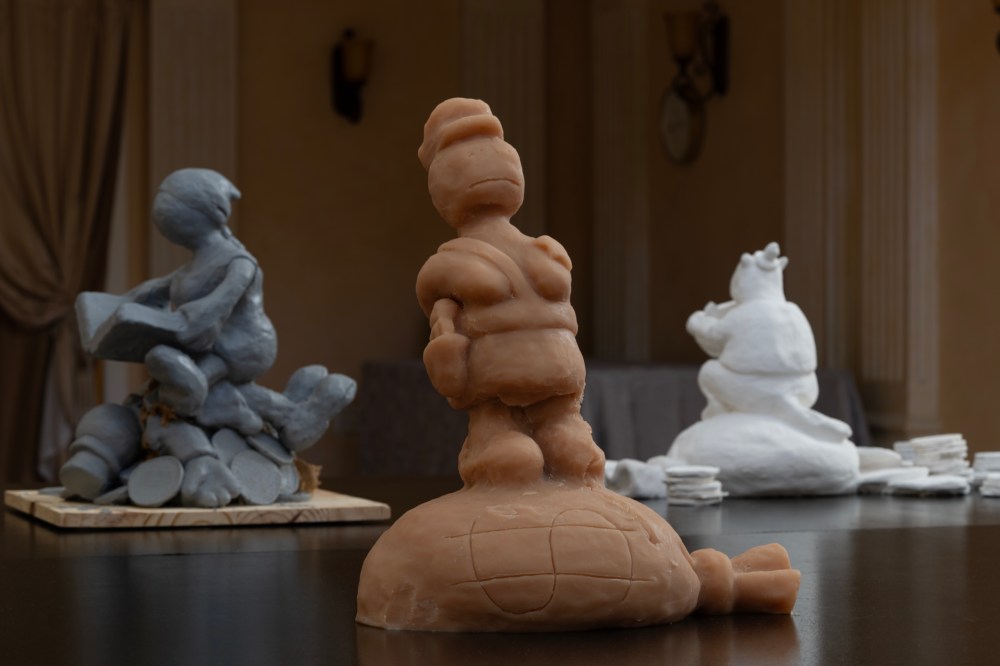
The midwinter art scene in New York City has unveiled a series of compelling exhibitions that explore themes of isolation and resilience. Notably, Jeffrey Joyal’s exhibition “my Life Underground” at the Gandt Gallery stands out for its innovative approach to public art. This exhibition features reproductions of Tom Otterness’s iconic public sculptures, originally installed in the subway station at Fourteenth Street and Eighth Avenue.
Joyal’s work, showcased in a transformed space at Gandt, consists of eleven casts of Otterness’s original bronze figures, which depict the diverse tapestry of New York’s commuters. Moving from a traditional gallery setting to a column-laden ballroom in a psychological facility in Astoria, Joyal captures a unique ambiance. His reproductions—crafted using plaster, rubber, and clay—highlight the tension between public art and private ownership.
While Joyal’s exhibition aims to celebrate the city’s underrepresented figures, it simultaneously critiques the privatization of public resources. Unlike Sherrie Levine’s appropriations of Marcel Duchamp’s “Fountain,” Joyal’s figures are removed from their original context, creating a sense of lone isolation. The smaller sculptures, arranged on a gallery table, face away from each other, stripping away the communal interactions that characterize their original setting. In doing so, Joyal emphasizes the current socio-political climate, where public assets are often viewed through a lens of potential profit.
The artist’s deliberate choice to reproduce Otterness’s cartoonish figures in low-quality materials—such as a chintzy bronze-like chrome plating—adds another layer of commentary. These fragile replicas serve to underscore the contrast between the original sculptures, which have endured as symbols of New York’s resilience, and their contemporary counterparts, which may crumble under the weight of their own irony.
Exploring Themes of Doubt and Persistence
Following Joyal’s exhibition, visitors can explore Mitchell Kehe’s “Bonded by the Spirit of Doubt” at 15 Orient in TriBeCa. This installation features an array of canvases and assemblage sculptures crafted from discarded materials. In works like “Untitled 1 (Bonded by the spirit of doubt),” the interplay of painted figures and voids evokes a sense of unresolved tension.
Kehe’s creations embody a precarious balance, as seen in sculptures like “First Layer of Revelation.” This piece forms a low wall from reclaimed items, showcasing the artist’s ability to create stability from fragility. The exhibition invites viewers to reflect on the themes of persistence amidst uncertainty, echoing the sentiments of resilience found in Joyal’s work.
Just a few blocks away at Derosia, Clémence de La Tour du Pin’s paintings counter Kehe’s transient themes with a portrayal of permanence and decay. Her works, constructed from oil paint, wax, and silk, evoke a sense of archaeology. The largest painting, simply titled “Untitled,” measures two and a half inches in height but stretches nearly twenty feet across, resembling a massive fossil or bone. The use of asphalt adds a layer of depth, reminiscent of tar pits, enhancing the notion that remnants of existence linger long after humanity has departed.
A Survey of Artistic Evolution
In Chinatown, John Duff’s exhibition at Reena Spaulings presents a retrospective of his six-decade career. Duff’s sculptures, made from resin, fiberglass, and concrete, illustrate the evolution of his artistic practice. Early works, such as “Untitled” from 1968, feature fragile, wax-like forms that resemble fossils, while more recent pieces, like “Untitled” from 2025, utilize concrete in a manner that challenges its rigidity.
The contrasting materials in Duff’s work raise questions about durability and decay. His concrete sculptures often appear on the brink of collapse, held together by a delicate balance. The piece “Untitled” from 2024, attached to a wall by a single knotted string, serves as a poignant metaphor for the fragility of existence in an era marked by uncertainty.
As January unfolds, these exhibitions collectively reflect a deeper meditation on the pressures of contemporary life. They explore the delicate interplay between isolation and community, permanence and transience, urging viewers to engage with the art and the broader societal issues it represents. In a time when the weight of the world can feel overwhelming, the presence of art offers a comforting reminder of resilience. For those seeking solace, the therapist in Queens may indeed be a fitting choice, but so too are the stories woven through New York’s vibrant art scene.