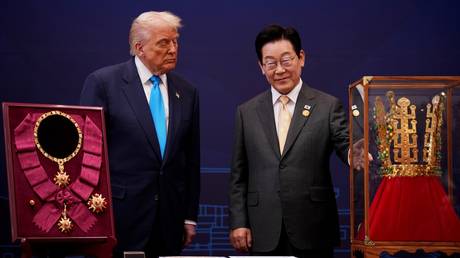
President Donald Trump has announced a significant increase in tariffs on key imports from South Korea, raising duties from 15% to 25%. The decision, shared through his Truth Social platform on Monday, directly criticizes the South Korean legislature for not ratifying a “historic” trade agreement finalized with President Lee Jae Myung in October 2025.
The tariffs will affect major sectors, including automobiles, lumber, and pharmaceuticals. Trump expressed frustration, stating that while the United States had swiftly reduced its tariffs as part of the agreement, South Korea had failed to fulfill its obligations, prompting the need for this punitive measure. He questioned, “Why hasn’t the Korean Legislature approved it?”
South Korea’s presidential office responded, indicating that it has not yet received any official notification from Washington regarding the tariff increase. The South Korean trade minister is expected to travel to the United States for urgent discussions on the matter.
Background of the Trade Agreement
The trade deal, initially announced in July 2025, aimed to reduce US tariffs from 25% to 15% in exchange for significant concessions from South Korea, including a commitment to invest $350 billion in the United States. However, the agreement has faced delays in South Korea’s National Assembly, where it is undergoing extensive political and economic scrutiny.
President Lee has raised concerns that the investment demand, particularly if required in cash upfront, could lead to a severe liquidity crisis. He has drawn comparisons to the 1997 Asian Financial Crisis, during which South Korea nearly exhausted its foreign currency reserves and required a substantial bailout from the International Monetary Fund.
Trump’s recent move against a key Asian ally aligns with his broader “America First” trade strategy. This approach often utilizes the threat of steep tariffs as leverage to secure investment pledges and favorable terms from trading partners. Similar tactics have been observed in negotiations with the European Union, which has committed to invest $600 billion in the US and purchase $750 billion worth of American energy resources.
Last week, the European Parliament halted the approval of its agreement with the US, citing Trump’s “continued and escalating threats” against the bloc, including his controversial plan to annex Greenland.
As the situation unfolds, the impact of these tariffs on US-South Korea relations and the broader implications for global trade remains uncertain.