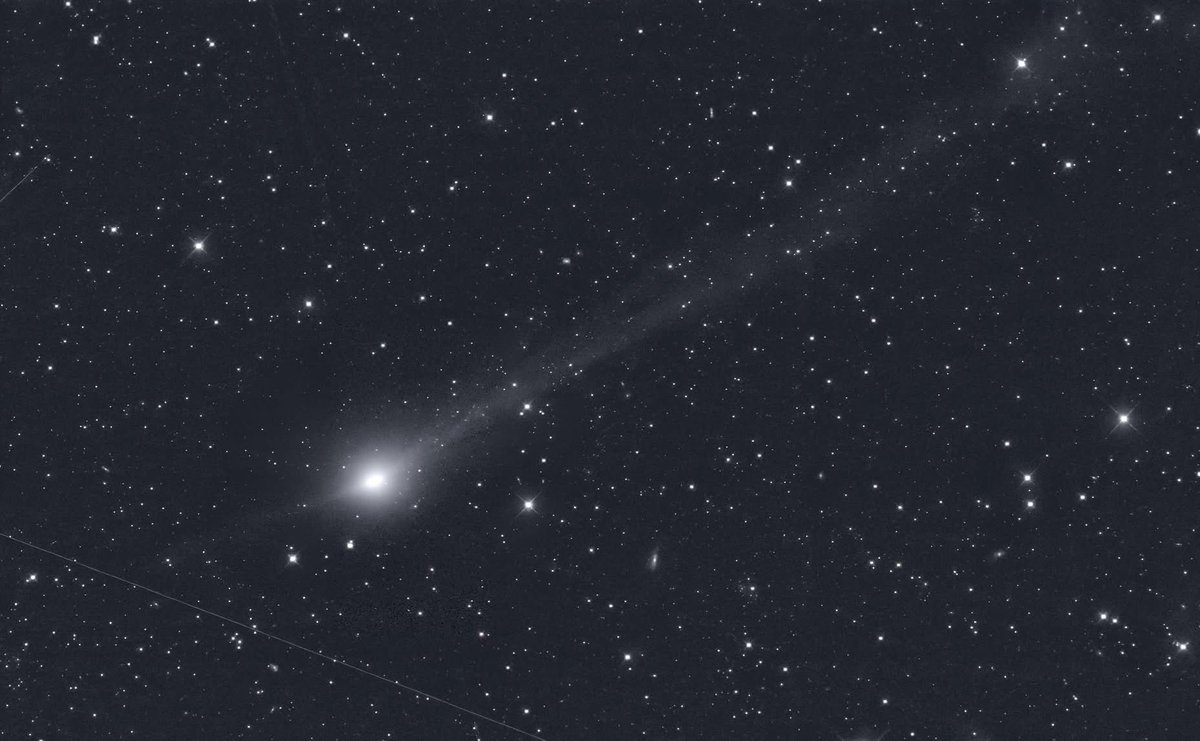
Astronomers have unveiled remarkable new images of comet 3I/ATLAS, which is currently traversing our solar system and displaying a striking double tail. The comet, first detected in July 2023, has attracted the attention of major space agencies, including the European Space Agency (ESA) and NASA, as it approaches its closest point to Earth.
As the comet nears its closest approach on December 19, 2023, both agencies have released fresh photographs revealing the comet’s chaotic surface and its unique characteristics. The images were captured using the Hubble Space Telescope and the Jupiter Icy Moons Explorer (Juice), providing critical insights into the comet’s composition and trajectory. These observations are crucial for understanding interstellar objects that originate beyond our solar system.
Comet 3I/ATLAS is only the third interstellar object recorded in our vicinity, making it a significant subject for scientific inquiry. Researchers have been eager to collect data about the comet before it departs our solar system. The intense sublimation of gases from the comet’s surface has accelerated, particularly during its closest approach to the sun in October, offering scientists valuable information about its materials.
The Hubble Space Telescope was among the first to observe 3I/ATLAS post-discovery, providing an early detailed view of its teardrop shape. On November 30, 2023, Hubble re-focused its Wide Field Camera 3 on the comet, producing clearer images despite the object being approximately 178 million miles (286 million kilometers) from Earth.
Meanwhile, the Juice mission, which is en route to study Jupiter and its moons, found itself in an optimal position to observe the comet earlier in November. At that time, Juice was about 41 million miles (66 million kilometers) away from 3I/ATLAS. Using five scientific instruments, including its Navigation Camera (NavCam), the mission team captured preliminary data revealing heat-driven activity on the comet resulting from solar interactions.
ESA tweeted, “Our @ESA_JUICE spacecraft captured comet #3IATLAS during its active phase, showing its glowing coma, plasma tail, and maybe even a dust tail.” The full dataset from the Juice mission will not be available until February 2024, as the spacecraft is currently using its main antenna to shield its instruments from solar radiation, limiting data transmission capabilities.
As 3I/ATLAS approaches Earth, experts have confirmed that it will pass at a safe distance of approximately 270 million kilometers (167 million miles) on December 19, 2023, remaining on the far side of the sun during this approach. For context, Earth is located around 150 million kilometers (93 million miles) from the sun.
NASA anticipates that 3I/ATLAS will remain observable through telescopes and other space missions for several months before it exits our solar system. While the comet’s appearance is a source of excitement, the Juice mission’s long-term objective is to investigate the potential for life on Jupiter’s largest moons—Ganymede, Callisto, and Europa. Launched in April 2023, Juice is scheduled to reach its destination by July 2031, where it will search for subsurface oceans beneath the icy crusts of these moons.
The ongoing research and observations of 3I/ATLAS signify a major stride in our understanding of interstellar phenomena, providing a glimpse into the mysteries of the cosmos.