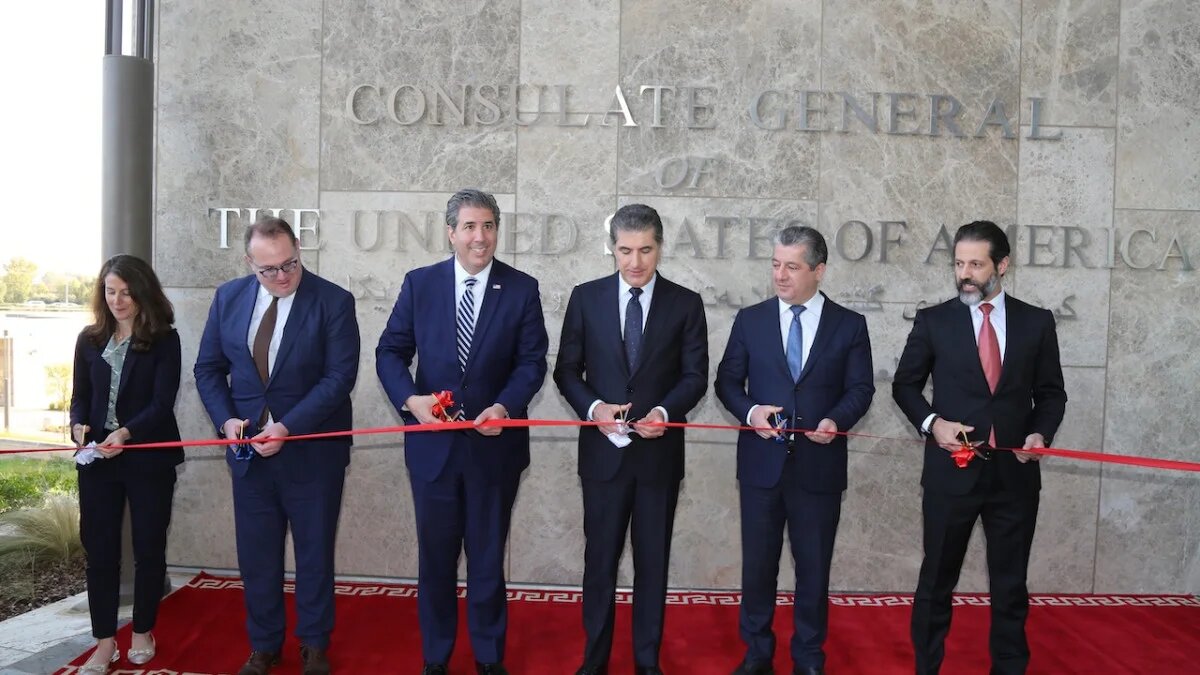
The United States inaugurated a new consulate in Erbil, the capital of Iraq’s semi-autonomous Kurdish region, on Wednesday. This expansive diplomatic compound covers 206,000 square meters, making it the largest US consulate globally. The development underscores the US commitment to the region, particularly as American troops transition from Baghdad and other parts of Iraq.
Construction of the consulate commenced in 2018, with estimated costs reaching around $800 million according to a US government report from 2019. The consulate serves as a vital hub for US diplomatic activities in a region that has historically supported American military operations against the Islamic State militant group (IS). Earlier in 2024, the US military announced the completion of its operations against IS within Iraq.
As part of a strategic shift, the US plans to redefine the rationale for its troop presence in Iraq from countering IS to fostering a mutual defense partnership with the Iraqi government. Reports indicate that most remaining US forces in Iraq are expected to relocate to Erbil, as highlighted by the Iraqi news outlet Kurdistan 24.
The deployment of US troops has long been a contentious issue in both the United States and Iraq. Many Americans express frustration over prolonged military engagements, while Iraqis reflect on the consequences of the 2003 invasion and subsequent conflicts. In a statement to Reuters, Prime Minister Mohammed Shia al-Sudani indicated that disarming Iran-backed militias would only be feasible once US troops withdraw from Iraq. Although his political bloc secured the most seats in the recent elections, his continuation in leadership remains uncertain amid coalition negotiations.
In an interview, al-Sudani expressed skepticism regarding the need for foreign military presence, stating, “There is no ISIS. Security and stability? Thank God it’s there… so give me the excuse for the presence of 86 states,” referring to the number of nations involved in the US-led coalition against IS since 2014.
The newly established consulate, which has no military function, aims to represent US citizens in the region, promote cultural and economic interests, and facilitate diplomatic engagement away from the capital. The Kurdistan region gained a degree of autonomy in 2005, establishing its own government structures, including a prime minister and a separate security force known as the Peshmerga.
During the opening ceremony, Michael Rigas, US Deputy Secretary of State for Management and Resources, emphasized the consulate’s role as a symbol of the long-term partnership between the US and Iraq. “The building we inaugurate today is a testament to our commitment,” Rigas stated. He underscored that the consulate reflects the significance of Erbil and the Kurdistan Region in US foreign policy.
The US views the Kurdistan region as a potential gateway to Iraq’s markets for American companies. Numerous US firms, including energy giant ExxonMobil, have substantial investments in the area. ExxonMobil has recently resumed operations in Iraq after a two-year hiatus, highlighting renewed interest in the region’s economic potential.
Erbil has historically competed with the central government in Baghdad over access to Iraq’s oil resources. In a bid to strengthen economic ties, the US has advocated for the reopening of a major pipeline that connects oil fields in the Kurdistan region to Turkey’s Ceyhan port. This pipeline, which had been closed in 2023 due to disputes over oil sales profits, resumed operations earlier this year, though its future remains uncertain as negotiations continue among Erbil, Ankara, and Baghdad.
Tensions persist, as evidenced by recent attacks attributed to Iranian-backed Iraqi militias. In July, a drone strike targeted oil fields in the Kurdistan region, and last month, a rocket attack disrupted operations at the Khor Mor gas field, leading to production halts and power outages.
The Erbil government has actively sought to deepen security ties with the US, including a request to purchase air defense systems, a move that has faced opposition from Baghdad and Iran. As the political landscape evolves in Iraq, the implications of the new consulate and the ongoing US military presence will continue to be closely monitored.