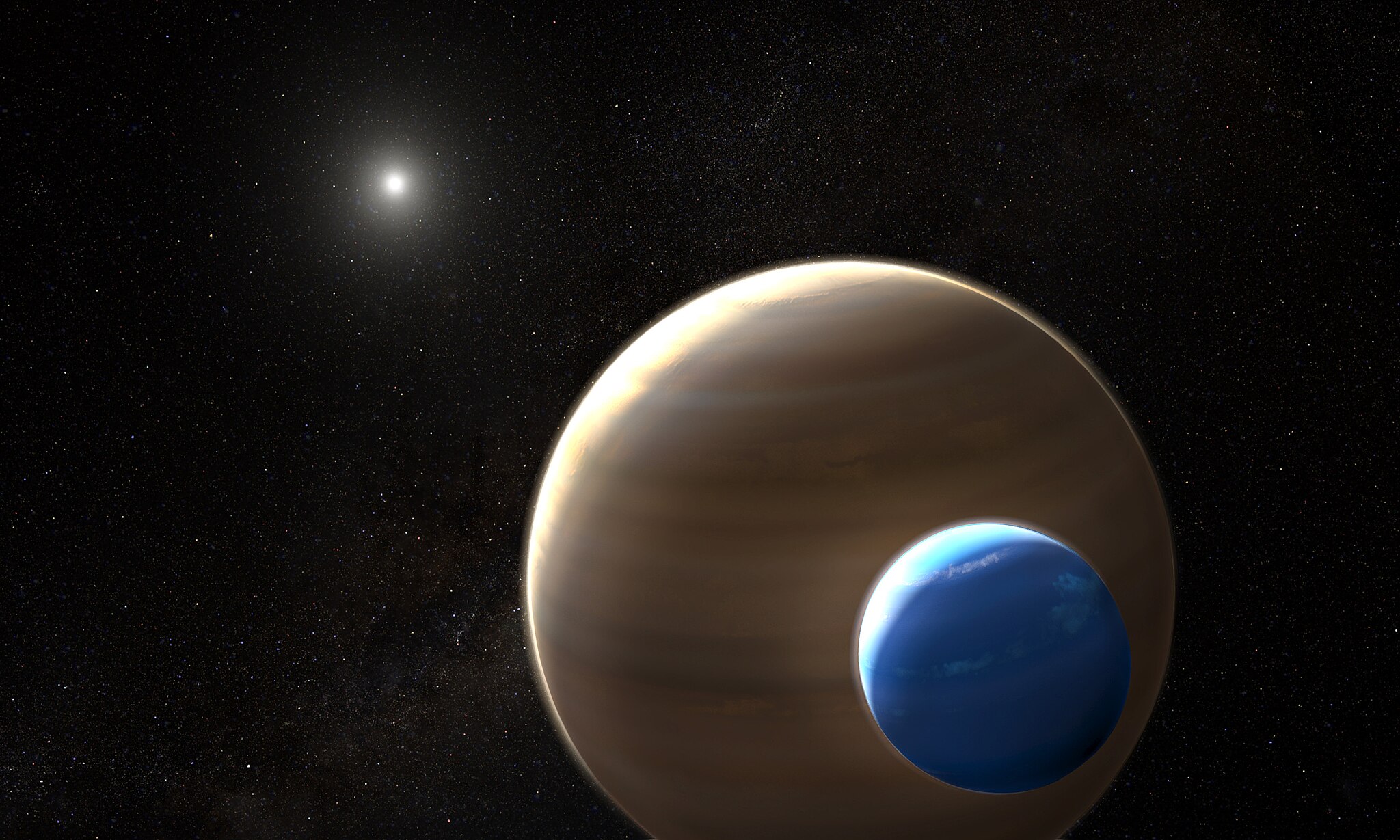
Astronomers have potentially identified the first exomoon candidate outside our solar system, marking a significant milestone in the exploration of celestial bodies. This candidate is located approximately 133 light-years from Earth and orbits a Jupiter-like exoplanet known as HD 206893 B. The exomoon candidate is notably massive, estimated to be around 0.4 Jupiter masses and more than seven times the mass of Neptune.
This discovery comes amid a surge in the identification of exoplanets, with over 6,000 confirmed since the beginning of the year alone. The implications of finding such a substantial exomoon could reshape our understanding of satellite formation in the universe.
Innovative Techniques Lead to Discovery
Unlike traditional methods that rely on observing dips in star brightness during planetary transits, the astronomers employed a technique called astrometry. Utilizing the Very Large Telescope in Chile and the VLTI/GRAVITY interferometer, the team meticulously tracked the motion of HD 206893 B. They were searching for gravitational perturbations that would indicate the presence of a companion body.
Through this method, they detected astrometric residuals—small deviations in the expected motion of the planet—suggesting the existence of a companion with a mass of approximately 0.4 Jupiter masses. This candidate orbits HD 206893 B with a period of about 0.76 years, presenting a compelling case for its classification as an exomoon.
The sheer size of this candidate poses a challenge to existing models of moon formation, which generally suggest that moons are considerably smaller than their host planets. In this case, the host planet, HD 206893 B, is itself extraordinary, boasting a mass around 28 Jupiter masses.
Cautious Optimism and Future Research
While this finding is exciting, the astronomical community remains cautious. The identification is provisional, and the authors of the study highlight that the apparent signals could result from systematic errors or noise rather than a genuine exomoon. Previous candidates like Kepler-1625b I, which appeared to be Neptune-sized, have faced challenges in confirmation, sometimes being reclassified as artefacts.
Further measurements using the GRAVITY instrument and other advanced technologies will be essential to determine whether the observed motion is indeed caused by a moon or simply noise. The prospect of a massive exomoon orbiting HD 206893 B signals potential advancements in astrometric techniques, suggesting that scientists may soon be able to identify moons with much smaller masses than Neptune.
The discovery of this candidate exomoon opens up new avenues for research. It could lead to direct imaging of previously known exoplanets and brown dwarfs, enhancing our understanding of these distant worlds. The astronomical community looks forward to ongoing investigations that might confirm the existence of this intriguing candidate and shed light on the nature of moons beyond our Solar System.
As the search continues, the possibility of discovering moons orbiting other stars seems more attainable than ever. The candidate exomoon around HD 206893 B serves as a tantalizing hint that we are on the brink of unlocking further secrets of the universe.