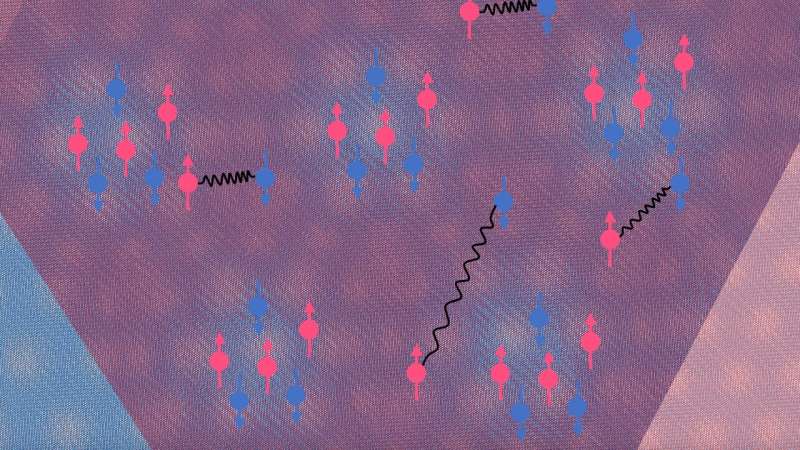
A research team from the Ecole Polytechnique Fédérale de Lausanne and Freie Universität Berlin has discovered significant superconductivity within a newly identified structure known as a supermoiré lattice. This breakthrough, detailed in a paper published on February 15, 2026, in the journal Nature Physics, could pave the way for innovative quantum materials with diverse applications.
Supermoiré lattices are formed when multiple layers of graphene are stacked and twisted at specific angles. These arrangements influence electron movement and can lead to strongly correlated states, such as superconductivity. The researchers focused on a twisted trilayer graphene structure featuring overlapping moiré patterns, which revealed unexpected electrical properties.
During the study, Mitali Banerjee, the paper’s senior author, shared that the team initially aimed to create a device where all twist angles were identical. However, research led by graduate student Zekang Zhou uncovered a fundamentally different phase diagram when measurements were taken. It became evident that the device’s response varied significantly depending on the direction of the applied electric field, leading to the emergence of distinct resistive states.
The team conducted extensive low-temperature electrical transport measurements to explore the superconductivity of this novel structure. By varying the carrier density and displacement field, they mapped the full phase diagram of their device. A critical transition to superconductivity was indicated by a dramatic drop in electrical resistance, nearing zero.
To confirm these observations, the researchers performed additional characterization measurements. They found that as temperature rose, the superconducting state was gradually suppressed, further emphasizing its sensitivity to external conditions. Their findings highlighted strong nonlinear transport behavior, indicating that the system transitions from superconducting to normal states above critical direct current values.
In analyzing the superconducting states, the team noted that the unique behavior of their device, which lacks mirror symmetry due to differing twist angles, still exhibited robust superconductivity. Banerjee explained the significance of their findings, stating, “Despite this symmetry breaking, we still observed robust superconducting regions with clear critical temperatures and critical magnetic fields.”
One of the standout aspects of their research was the identification of the supermoiré lattice through the observation of Brown-Zak oscillations. These oscillations occur when electrons move under the influence of a magnetic field, displaying synchronized patterns of resistance that confirm the presence of a larger periodic structure.
The implications of this work extend beyond mere scientific curiosity. Over the past decade, twisted graphene systems have emerged as promising platforms for exploring quantum phases. Banerjee noted, “Our findings demonstrate that in twisted multilayer systems, the interference between distinct moiré lattices constitutes a new degree of freedom.” This discovery not only enhances the understanding of existing quantum phases but also opens avenues for designing new quantum states.
The research team plans to delve deeper into the conditions necessary to stabilize supermoiré lattices and investigate the microscopic origins of superconductivity within their system. Banerjee remarked on the project’s unexpected trajectory, emphasizing the potential for future studies to inform the design of materials with novel electronic properties.
As this field progresses, the possibilities for developing quantum devices and advanced technologies continue to expand, driven by discoveries such as those presented in their recent study. The work led by Banerjee and Zhou represents a significant step forward in the quest for understanding and harnessing the unique properties of twisted graphene structures.