Samples collected from the far side of the Moon have provided new insights into the significant differences between its two hemispheres. Research conducted by scientists at the Chinese Academy of Sciences (CAS) has analyzed rocks returned by the Chang’e-6 mission, revealing that the near and far sides of the Moon differ in chemical composition, magmatic activity, and crust thickness. This study suggests that these disparities may be linked to the ancient meteorite impact that formed the Moon’s South Pole-Aitken Basin (SPA).
The Chang’e-6 mission, which launched on May 3, 2024, marks a continuation of China’s ambitious lunar exploration program, which began with the launch of Chang’e-1 in 2007. The previous mission, Chang’e-5, returned 1.7 kg of samples from the near side in 2020, marking the first lunar samples returned to Earth in nearly 50 years. The Chang’e-4 mission made history by landing in the SPA’s Von Kármán crater, the largest and one of the oldest known impact craters in the solar system, estimated to be between 4.2 and 4.3 billion years old.
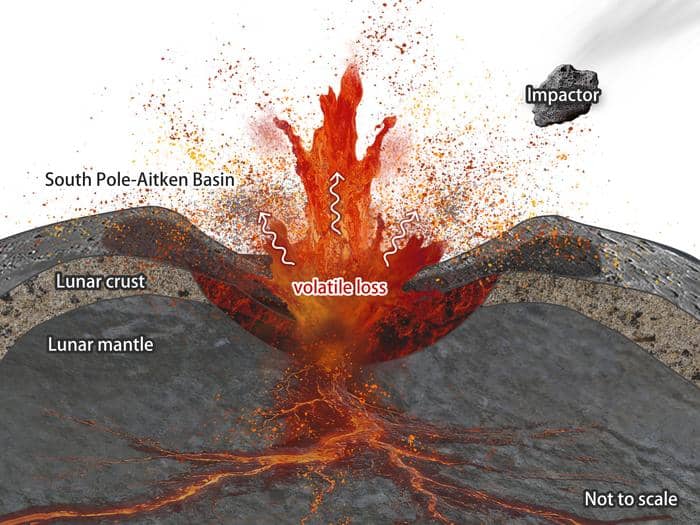
Researchers from CAS focused on measuring potassium and iron isotopes in four samples from the SPA. They discovered that the ratio of potassium-41 to potassium-39 in these samples was significantly higher than in those collected from the near side, including samples from NASA’s Apollo missions. Study leader Heng-Ci Tian noted that this isotopic ratio serves as a remnant of the colossal impact that formed the basin.
Tian explained, “The impact generated such extreme temperatures and pressures that many volatile elements in the Moon’s crust and mantle, including potassium, evaporated into space.” The lighter potassium-39 isotope evaporates more readily than the heavier potassium-41, leading to the observed increase in the ratio of potassium-41.
This research aligns with earlier findings from Chang’e-6, which indicated that the far side’s mantle contains less water than that of the near side. Prior to reaching this conclusion, the research team explored multiple alternative explanations for the observed isotopic differences. They considered cosmic ray irradiation, magma processes, and meteorite contamination, ultimately determining these factors had minimal impact on the results.
Tian emphasized that their findings offer the first concrete evidence that an impact event of this magnitude can alter the Moon’s deep materials. “Our results suggest that large impacts play a crucial role in shaping the Moon’s crust and mantle,” he stated. The suppression of volatile elements could limit volcanic activity, explaining the relative scarcity of dark volcanic plains, or maria, on the far side compared to the near side.
“The loss of moderately volatile elements—and likely highly volatile elements—would have inhibited magma generation and volcanic eruptions on the far side,” Tian explained. The study proposes that the impact responsible for the SPA not only transformed the lunar landscape but also contributed to the observed differences in volcanic distribution across the Moon’s hemispheres.
The research team faced significant challenges due to the fine-grained nature of the Chang’e-6 samples, which complicated the selection of large individual grains for analysis. To address this, they developed an ultra-low-consumption potassium isotope analytical protocol, allowing for high-precision measurements at a milligram level.
While the findings provide a promising start, researchers plan further analyses of additional moderately volatile element isotopes to confirm their conclusions. Tian expressed enthusiasm for combining these results with numerical modeling to better understand the global effects of the SPA impact on the Moon’s geology.
The research findings are detailed in the Proceedings of the National Academy of Sciences, marking a significant step forward in lunar science and exploration.