
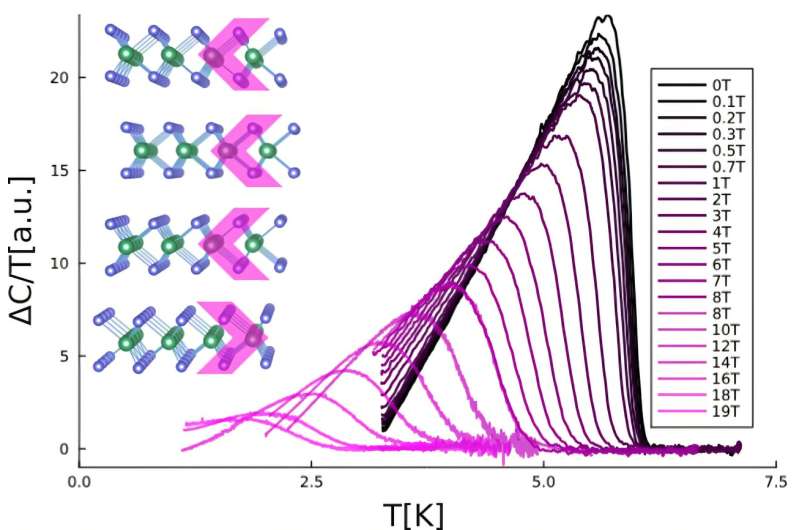
A recent study has revealed that breaking the inversion symmetry of three-dimensional (3D) crystals can allow them to mimic the unique superconductivity found in two-dimensional (2D) materials. Conducted by a team from the Institute of Experimental Physics in Košice, this research, published on February 6, 2026, in Physical Review Letters, offers a new pathway for exploring superconductivity without the complexities associated with traditional methods.
Two-dimensional materials, such as graphene and transition metal dichalcogenides (TMDs), exhibit remarkable quantum phenomena that are challenging to achieve in the three-dimensional realm. TMDs, in particular, possess desirable properties like strong spin-orbit coupling and superconductivity. A notable example is the single-layer film of NbSe2, which showcases Ising superconductivity (IS) capable of withstanding high magnetic fields aligned with the crystal plane. This resilience opens doors for potential applications, including topological superconductivity and the emergence of Majorana fermions.
Despite their fascinating properties, 2D materials often suffer from degradation, limiting their practical applications. In contrast, 3D materials are more robust and can be easily scaled. As a result, researchers have sought ways to preserve the remarkable attributes of 2D materials within their 3D counterparts. A common strategy involves intercalating functional layers between TMD sheets, a method that has shown promise in maintaining interlayer conductivity while retaining 2D properties. However, intercalation can introduce complexity and extrinsic effects.
In their innovative study, the team from Košice demonstrated that intercalation is unnecessary. Instead, they focused on symmetry engineering. By breaking the inversion symmetry of the otherwise centrosymmetric crystal lattice in bulk NbSe2, they found that IS could be retained without the need for chemical alterations. Their research centered on the 4H a-NbSe2 polytype, which exhibits broken symmetry due to its unique stacking of four atomic layers.
To confirm their findings, the researchers employed various experimental techniques to accurately identify the crystal structure of the sample. They then utilized heat capacity measurements, which provide insights into the bulk properties of the material. Their results indicated that the bulk superconductivity in 4H a-NbSe2 could withstand magnetic fields nearly three times greater than the Pauli limit. This method of characterization is advantageous, as it mitigates the influence of spurious 2D effects that can arise in transport measurements.
The implications of this research are significant. The findings suggest that the stacking order and symmetry of TMDs can be manipulated to tune their fundamental electronic properties. This symmetry-only approach simplifies the materials design process by avoiding the complexities introduced by chemical intercalation. It provides a robust and scalable platform for further investigation into Ising superconductivity and its potential applications in practical devices.
As the team led by Dominik Volavka concludes, their work illustrates the importance of symmetry in the study of superconductivity. By enhancing our understanding of how symmetry can influence electronic properties, this research paves the way for new innovations in the field. The full study can be accessed in Physical Review Letters and is available on arXiv for those interested in the technical details.


