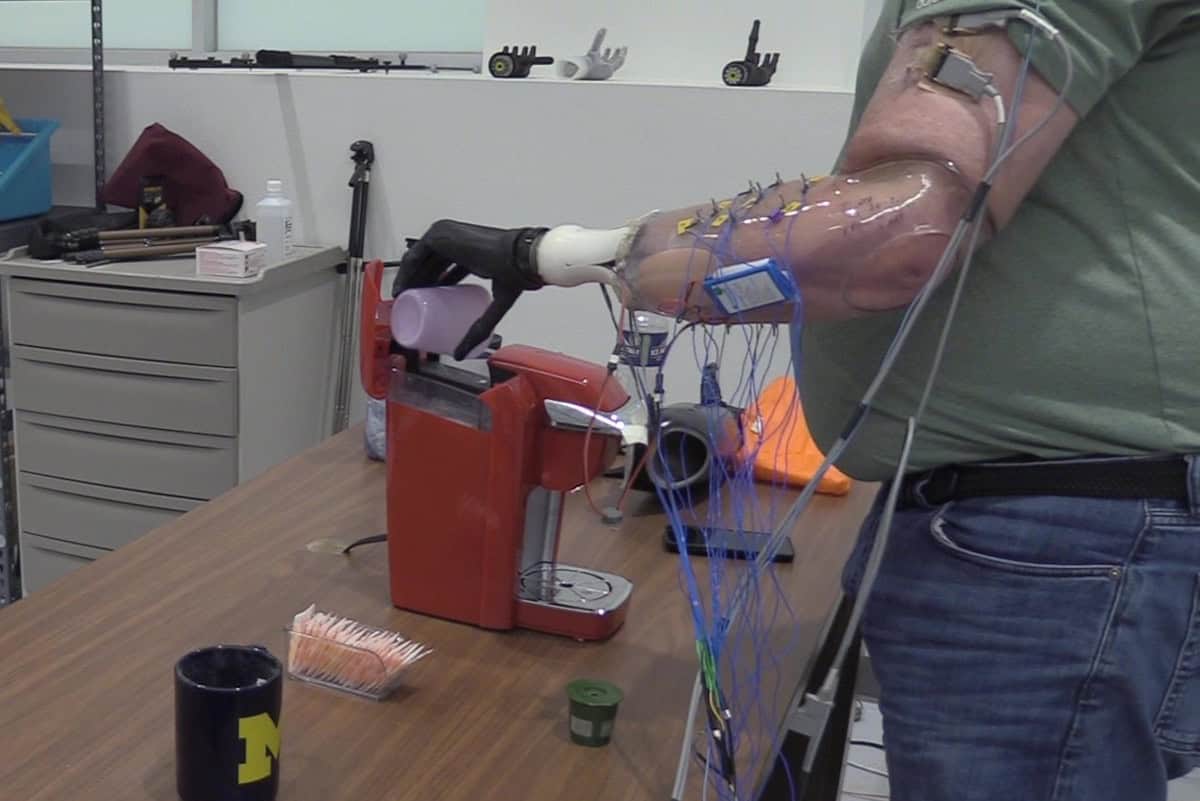
Research from the University of Michigan has demonstrated that implanted electrodes can significantly enhance the control of prosthetic hands, offering users a more intuitive and reliable experience. Traditional prosthetic limbs often rely on surface electrodes that measure electrical activity from muscles under the skin. However, these surface electrodes can suffer from various limitations, such as inconsistent positioning and interference from sweat or user movement.
The study, published in the Journal of Neural Engineering, highlights how implanted electrodes, which are surgically placed within the muscles, can improve signal quality and stability. These electrodes target deeper muscle tissues, providing a higher signal-to-noise ratio and reduced susceptibility to fluctuations caused by daily activities.
One of the key innovations discussed in the research is the use of Regenerative Peripheral Nerve Interface (RPNI) surgery. This technique involves grafting muscle tissue to nerves in the residual limb, allowing the implanted electrodes to access signals from muscles that may have been lost during amputation. Senior author Cynthia Chestek emphasized the dual benefits of RPNI, stating, “They provide a target for nerve endings that prevent the formation of painful neuromas, and that may in turn help reduce phantom limb pain.”
The research team conducted trials involving two individuals with forearm amputations who had EMG electrodes implanted into RPNIs and residual limb muscles. Participants performed various tasks that tested their ability to control a virtual hand and wrist by mimicking movements displayed on a screen. The results demonstrated that control over prosthetic movements was faster, more accurate, and more reliable with implanted electrodes compared to surface electrodes.
In a controlled environment, the implanted electrodes achieved average accuracies of 82.1% and 91.2% for the two subjects, while surface electrodes displayed significantly lower accuracies of 77.1% and 81.3% for gelled electrodes, and 58.2% and 67.1% for dry-domed electrodes, respectively. Even under dynamic conditions, where participants mimicked daily activities, the implanted electrodes maintained performance while surface electrodes demonstrated instability.
The study further assessed a real-world scenario known as the “Coffee Task,” which required participants to perform actions such as placing a cup into a coffee machine and pouring sugar into it. When controlled by implanted electrodes, participants completed the task successfully on all attempts, while surface control resulted in time constraints, with two out of three attempts reaching the maximum time limit of 150 seconds.
This research indicates that the integration of wrist control with hand movements can significantly enhance the functionality of prosthetics. Without active wrist movement, users often need to compensate with larger body movements, which can be cumbersome. The findings suggest that users can achieve better precision and less movement strain when wrist rotation is enabled.
Looking ahead, Chestek noted the potential for future advancements: “The next step would be to pursue continuous, rather than discrete, movement for all of the individual joints of the hand – though that will not happen quickly.” This ongoing research aims to provide prosthetic users with greater independence and improved quality of life, marking a significant step forward in prosthetic technology.