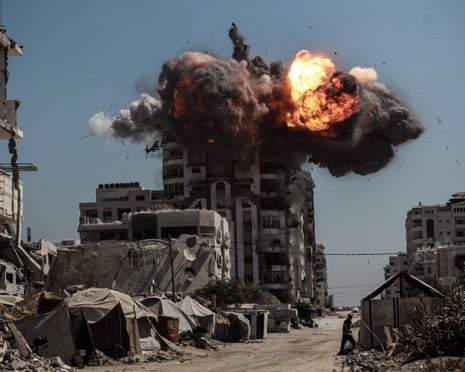
Israel’s military has officially acknowledged that the death toll reported by health authorities in Gaza is broadly accurate, a significant shift from its previous stance. A senior security official informed Israeli journalists that approximately 70,000 Palestinians have died due to Israeli military operations since October 2023, not accounting for those who are missing. This marks the first time Israel has publicly estimated casualties from the ongoing conflict.
The Gaza Health Authorities reported that the direct toll from Israeli attacks has exceeded 71,660 individuals, with at least 10,000 presumed buried under the rubble of destroyed buildings. For over two years, Israeli officials have dismissed Palestinian casualty figures as “Hamas propaganda,” calling them inaccurate. This sudden acknowledgement raises broader questions regarding Israel’s justification for its military actions in Gaza.
Concerns regarding civilian casualties have escalated following this change in narrative. The Israeli military previously claimed to have killed about 22,000 militants in Gaza, suggesting that a significant majority of the casualties—over two-thirds—were non-combatants. This figure contradicts a classified Israeli military database, which indicated that around 83% of casualties were civilians, and is notably above the 50% civilian casualty rate previously stated by Prime Minister Benjamin Netanyahu.
A military spokesperson refrained from confirming the death toll presented at the briefing, stating that “the details published do not reflect official IDF data.” The Palestinian database lacks a detailed breakdown of fighters versus non-combatants but does identify most deceased individuals by name, date of birth, and Israeli-issued identity numbers.
UN and Rights Groups Weigh In
The shift in Israel’s stance has prompted scrutiny from various international organizations. A United Nations commission, along with human rights organizations and scholars, have accused Israel of committing acts that could be classified as genocide in Gaza. Following the recent briefing, the Israeli publication Haaretz questioned, “What other accusations could turn out to be true?” suggesting a need for the Israeli public to reassess the credibility of the government and military regarding their conduct in the region.
Historically, during past conflicts in Gaza, the final casualty counts recognized by Israel and independent observers, including the UN, have been in alignment with Palestinian figures. However, the recent acknowledgment received limited coverage in Israeli media. While major outlets attended the briefing, only Yedioth Ahronoth initially reported the figure, highlighting diplomatic negotiations involving the US, Qatar, and Israel.
Reopening of Rafah Crossing
In a related development, the Israeli military announced it would reopen the Rafah crossing between Gaza and Egypt on Sunday, the first time since Israeli forces took control of the border area in May 2024. This reopening allows Palestinians who left Gaza to apply for re-entry for the first time since the outbreak of the conflict. A European Union force will oversee the crossing, although Israel will maintain full control over all entries and exits.
While the reopening is framed as a crucial part of the US-led efforts to advance a ceasefire plan proposed by former President Donald Trump, it is important to note that the crossing will only accommodate pedestrians. This limitation means it will not alleviate the shortages of essential supplies, such as food, medicine, and shelter, which have become increasingly dire in Gaza.
As Israel navigates this complex landscape of military operations, humanitarian concerns, and shifting narratives, the implications of these developments will likely continue to resonate both domestically and internationally.