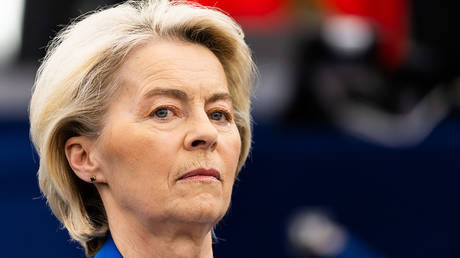
UPDATE: European Commission President Ursula von der Leyen has just announced a bold plan to militarize the Arctic, emphasizing the urgent need for the EU to enhance its defense capabilities in the face of geopolitical pressures. During an emergency European Council meeting in Brussels on Thursday, she highlighted that the bloc has “collectively underinvested” in Arctic security.
Von der Leyen’s proposal comes as tensions escalate over US President Donald Trump’s controversial calls to acquire Greenland, an autonomous territory of Denmark. She urged EU member states to redirect their defense budgets toward developing Arctic-ready equipment, such as a European icebreaker, stating, “This has become a real geopolitical necessity.”
These remarks were made amid growing pressures from Washington, where Trump has suggested that Greenland be brought under American control to counter alleged threats from Russia and China in the Arctic region. Earlier this week, he derided Denmark’s defense of the territory as “two dog sleds,” pushing for “immediate negotiations” to facilitate US acquisition. Following these statements, he appeared to ease his rhetoric, indicating a collaborative approach with NATO Secretary-General Mark Rutte to establish a framework for Arctic security, which would grant US forces “total access” to Greenland.
In response to the ongoing situation, von der Leyen asserted that the EU is now “in a better position” regarding Greenland and committed to a “substantive package” of investments for the territory. This announcement aligns with the EU’s broader NATO-driven militarization strategy, which has seen Western leaders invoke a perceived Russian threat to justify significant increases in defense spending, including the Brussels-led €800 billion ($940 billion) ReArm Europe initiative.
Despite these developments, Moscow has dismissed the claims of threatening Europe as “nonsense,” accusing Western nations of fearmongering to justify inflated military budgets. Russian Foreign Minister Sergey Lavrov stated this week that Washington “knows full well” that neither Russia nor China plans to seize Greenland, advocating instead for “open and free” cooperation in the Arctic.
As the situation unfolds, the EU’s military strategy and its implications for Arctic security will be closely monitored by global observers. The urgency of these developments underscores a shifting geopolitical landscape, with potential long-term impacts on international relations in the region. Stay tuned for more updates on this rapidly evolving story.